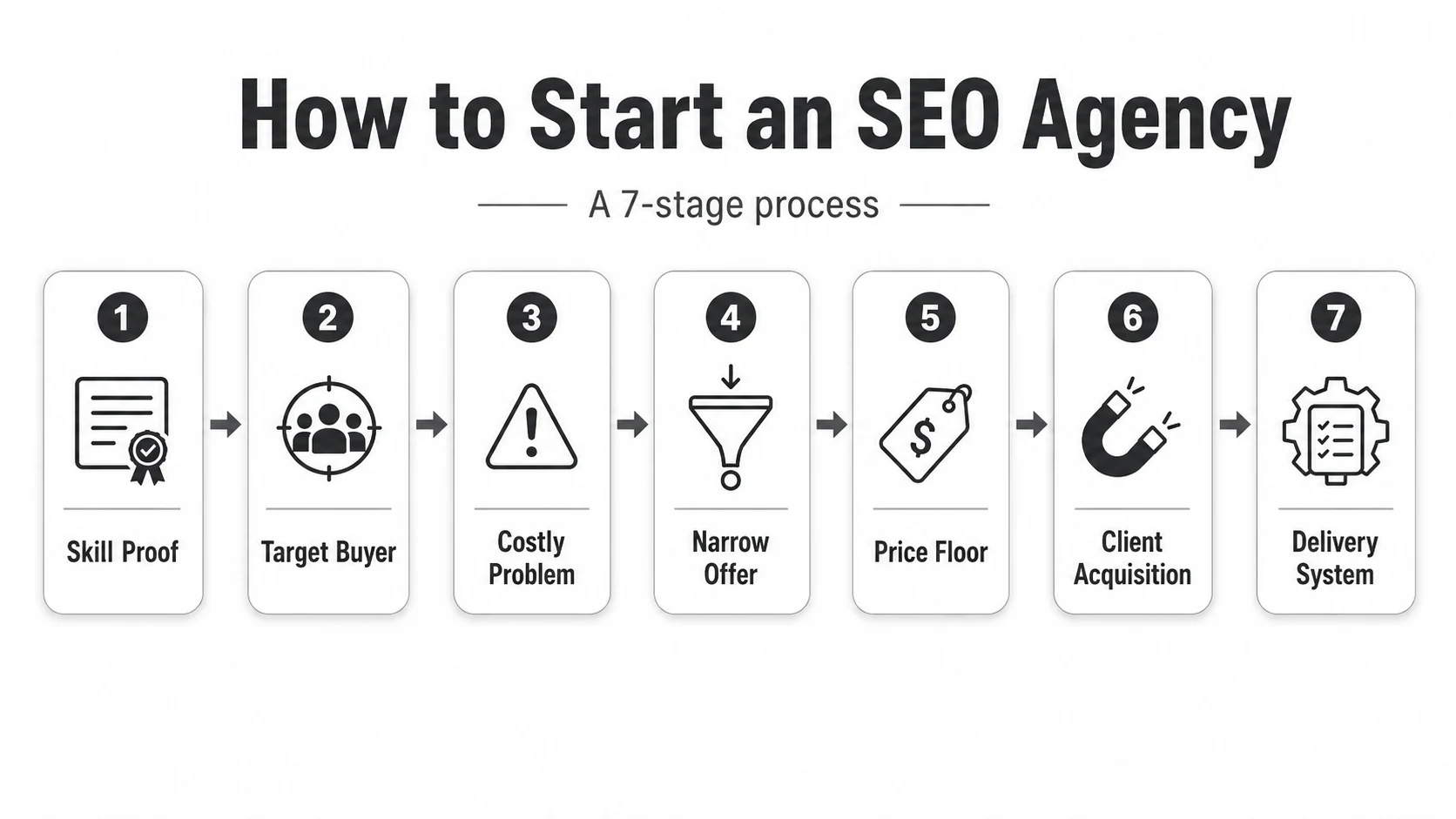
To learn how to start an SEO agency, prove one search skill, choose one buyer, package one measurable service, calculate its delivery cost, build evidence, and sell through one repeatable channel.
Your first 90 days should test four mechanisms:
- Whether buyers recognize the problem
- Whether your offer earns serious conversations.
- Whether your process produces an acceptable result.
- Whether the price leaves money after delivery.
A logo, a 20-page website, and six service pages cannot compensate when one of those four mechanisms fails.
What is an SEO agency?
An SEO agency helps a business gain qualified visibility in unpaid search results by improving crawlability, indexability, content relevance, internal relationships, external authority signals, or measurement.
Google’s guide lists site-structure reviews, technical advice, content development, keyword research, market expertise, and optimization for generative AI among the services that an SEO provider may deliver.
Remember, a client pays for a commercial mechanism that will benefit the business rather than a collection of tasks.
| SEO agency deliverable | Mechanism | Evidence the client can inspect |
|---|---|---|
| Technical SEO | Finds and fixes crawling, indexing, rendering, duplication, and internal-link problems | Crawl reports, Search Console evidence, and implemented tickets |
| Content strategy | Maps search intent and business value to specific pages | Keyword-to-page map, content briefs, and published URLs |
| On-page SEO | Clarifies page purpose, headings, entities, media, and internal relationships | Before-and-after page versions and Search Console query data |
| Link acquisition | Earns relevant third-party references and referral paths | Published pages, topical fit, link attributes, and referral traffic |
| Local SEO | Improves eligibility for location-specific searches | Google Business Profile actions, calls, and direction requests |
| SEO reporting | Connects completed work with search and commercial outcomes | Search Console, GA4, CRM leads, and conversion data |
Google Search Console should remain the primary source for Google Search performance because Google Search Central states that third-party SEO tools do not possess its internal ranking data.
Therefore, Ahrefs DR, Semrush Authority Score, and estimated traffic can support research, but their mechanism remains an external model rather than a direct Google ranking measurement.
Can you start an SEO agency with no experience?
Google Search Central warns that an irresponsible SEO can damage both a website and its reputation, and Google advises buyers to reject any provider that guarantees a first-place ranking.
You can begin without agency ownership experience when your offer remains narrower than your proven ability.
A backlink-prospecting pilot may fit someone who can inspect websites and manage outreach; a complete enterprise SEO retainer requires technical diagnosis, content planning, analytics, stakeholder management, quality control, and commercial prioritization.
Use this 20-point readiness test
Score each statement with 0 for “cannot perform,” 1 for “can perform with review,” or 2 for “can perform and explain independently.”
- You can use Google Search Console to separate crawling, indexing, ranking, and click-through problems.
- You can crawl a small website with Screaming Frog or an equivalent crawler and rank the top five findings by business impact.
- You can map one search intent to one page without producing duplicate pages for minor keyword variants.
- You can write or review a content brief that specifies audience, query, evidence, entities, media, and conversion action.
- You can distinguish editorial, sponsored, nofollow, and user-generated links.
- You can estimate the hours, software allocation, external costs, and revision risk of one monthly engagement.
- You can reject a tactic that conflicts with Google’s spam policies, even when the prospect offers immediate payment.
- You can show one owned, employed, freelance, or pilot example where your work changed a measurable outcome.
- You can conduct a discovery call without guaranteeing rankings, traffic, or revenue.
- You can document one delivery process so another person can repeat it without guessing.
| Score | Commercial decision |
|---|---|
| 0–11 | Practise on an owned property or supervised project before charging |
| 12–15 | Sell one controlled pilot with written exclusions and senior review |
| 16–20 | Sell one narrow paid service and measure delivery economics |
Download this checklist here with auto score calculation.
The 16-point threshold works because a paid offer requires both technical execution and business control. A founder who scores 18 on SEO tasks but 0 on scoping can still lose money through revisions, hidden dependencies, and work that the contract never priced.
Which SEO niche should you choose?
Choose a niche where organic search affects a valuable customer action and where you can repeatedly reach the decision-maker.
The niche should narrow your sales message, proof, process, and reporting model; a label such as “Dental SEO” has value when it contains clinics, software vendors, publishers, pharmacies, and multinational manufacturers with different buying processes.
Promethean Research found that agencies which reduced their service mixes in 2025 grew 13% on average and produced 30% net margins. The mechanism is operational: every added service creates another scoping model, skill requirement, review standard, tool requirement, and failure path.
Score a niche before building the brand around it
Rate each factor from 1 to 5, multiply the rating by its weight, and require at least 70 points out of 100 before committing the agency’s positioning.
| Niche factor | Weight | Question to test |
|---|---|---|
| Search dependence | 20 | Does organic discovery affect pipeline, bookings, sign-ups, or sales? |
| Customer value | 15 | Can one additional customer justify the proposed monthly fee? |
| Buyer reachability | 15 | Can you identify decision-makers through directories, LinkedIn, communities, or partners? |
| Repeated pain | 15 | Do at least 6 of 10 buyer interviews describe the same problem? |
| Delivery fit | 15 | Can your current skills solve the problem without concealing major gaps? |
| Proof access | 10 | Can you create an owned result, audit, pilot, or publishable case study? |
| Retention potential | 5 | Does the problem require recurring execution or measurement? |
| Policy exposure | 5 | Can you deliver without deceptive content or manipulative links? |
Download the checklist here.
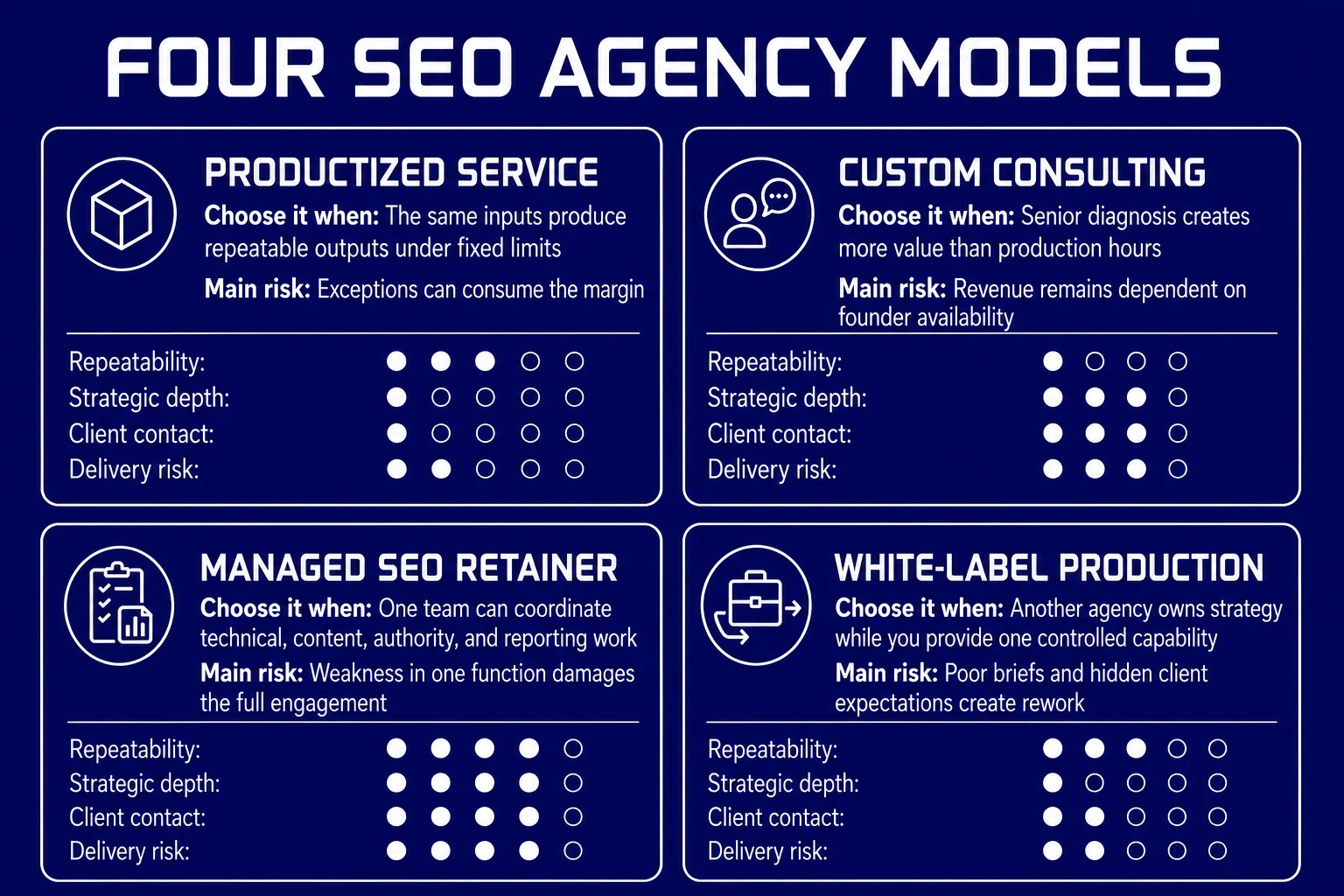
Which service model should you use?
How much does it cost to start an SEO agency?
The starting cost depends on the service mechanism rather than the word “agency.” A consultant can begin with a computer, a payment method, and first-party tools; meanwhile, a link-building service may also require prospecting software, content costs, publisher payments, and a cash reserve for replacements.
Ahrefs published a survey of 439 SEO providers in 2024 and found that 78.2% used monthly retainers. Ahrefs reported an average agency retainer of $3,209 per month, while providers with two years or less in business averaged $1,540.52.
Pricing does not equal profit. Promethean Research reported a 13% average after-tax net margin for digital agencies in 2025, which means a $2,000 retainer can still perform poorly when delivery, revisions, software, management, sales, and tax consume most of the fee.
Calculate your minimum profitable retainer
Use this mechanism:
Total cost = direct delivery cost + external production cost + software allocation + account+ revision reserve + operating profit + management cost
Minimum retainer = Total Cost / (1 - Target profit margin)
A working model for a specialist SEO service could use the following assumptions:
| Cost component | Working amount | Calculation |
|---|---|---|
| Specialist delivery | $600 | 20 hours × $30 |
| External production | $400 | Content, design, data, or placement costs |
| Software allocation | $120 | Shared tools divided across active clients |
| Account management | $240 | 6 hours × $40 |
| Revision reserve | $136 | 10% of the first four cost lines |
| Delivery cost | $1,496 | Total before operating profit |
| Price at a 30% margin | $2,137 | $1,496 ÷ 0.70 |
The calculation divides cost by 0.70 because a 30% margin leaves 70% of revenue for cost. Adding 30% to the $1,496 cost produces $1,944.80, but that price creates a 23.1% margin rather than a 30% margin.
Use a lean tool stack
| Business function | Start with | Upgrade trigger |
|---|---|---|
| Search performance | Google Search Console and GA4 | Client reporting requires automated consolidation |
| Technical crawling | Screaming Frog free or limited mode | Client sites exceed the free crawl limit |
| Keyword and backlink research | One paid suite such as Ahrefs or Semrush | Research time or data gaps affect paid delivery |
| Project control | Notion, Trello, ClickUp, or one spreadsheet | More than 3 active clients create missed dependencies |
| Sales pipeline | One CRM or structured spreadsheet | Follow-ups exceed the founder’s daily review capacity |
| Payment | One primary and one backup route | Cross-border delays threaten contractor or publisher payments |
How do SEO agencies get their first clients?
Your first acquisition system should connect a named buyer, an observable trigger, and a specific service mechanism.
A message to “business owners who need SEO” contains all three:
- Who exactly am I talking to? (Buyer)
- Why am I contacting them now? (Reason for contact)
- What evidence do I have that they actually need my help? (Evidence)
Belkins made a study that reported more than 7.5 million cold emails sent during 2025 and reported a 0.45% average reply rate for net-new cold contacts. Founders and owners replied at 0.57%, while companies with 11–50 employees replied at 0.49%; those figures show why audience selection matters before message wording.
I would use three acquisition channels during the first 60 days:
- Partnerships with web developers, content agencies, or SEO agencies that lack your specialist capability.
- Hand-built outbound based on a visible search or delivery problem.
- Evidence-led content that demonstrates a calculation, audit method, experiment, or operating process.
Wait to run paid ads until you know your offer works. Talking to 10 potential customers first can reveal problems for free.
Model the client pipeline backward
The following figures are planning assumptions rather than published conversion benchmarks:
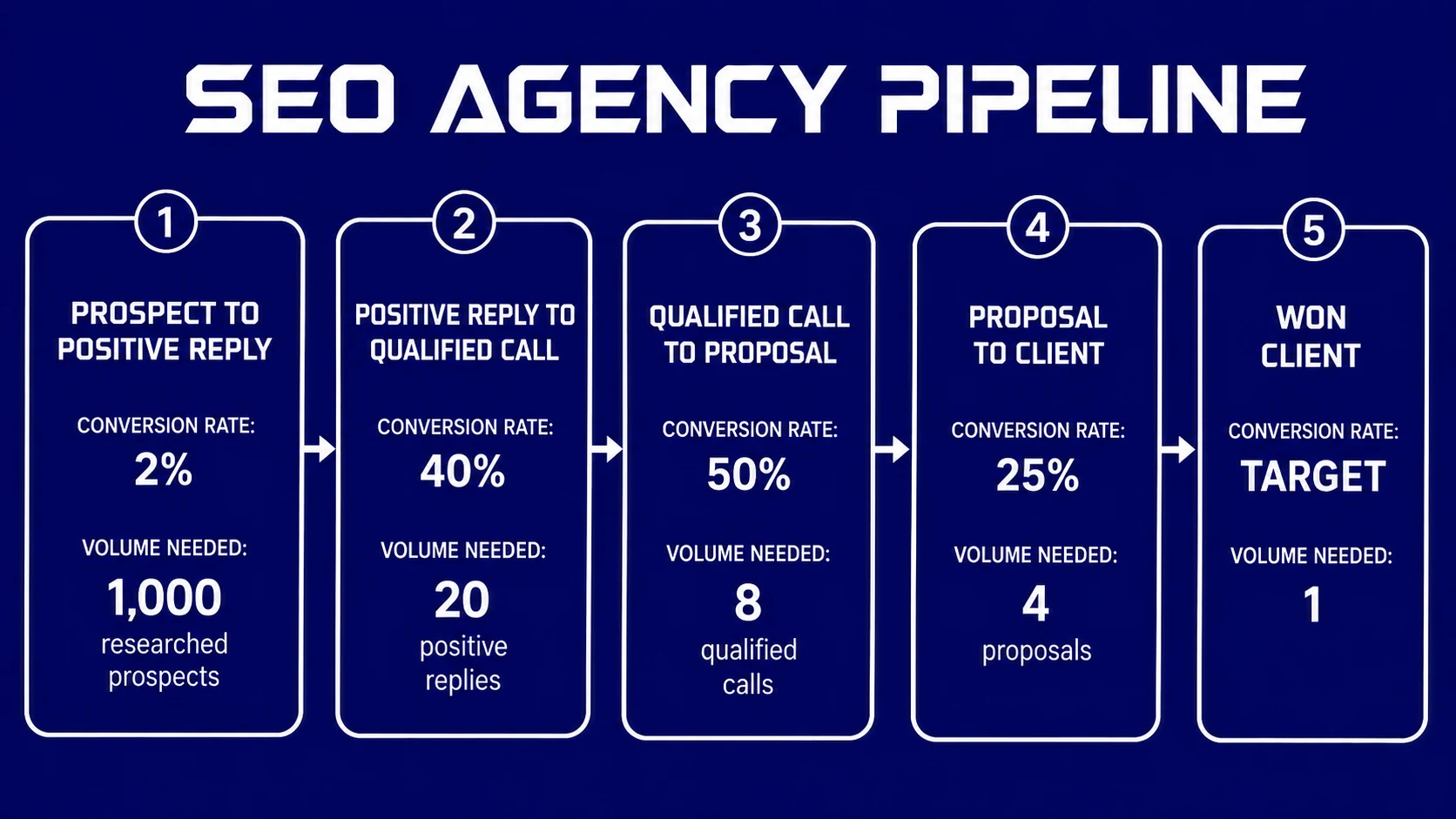
A 2% positive-reply assumption is more optimistic than Belkins’ 0.45% all-reply average because a good model assumes tighter targeting, manual research, and multiple channels.
Replace the 2% figure with your observed rate after the first 100 contacts, because the agency’s own data should control future volume planning.
Use this five-step first-client process
- Talk to 10 potential clients. Ask about their biggest SEO challenge, what they've already tried, and what they want to achieve.
- Create one proof of your work. Use a personal project, a case study, a website you've improved, or a small pilot project.
- Build a list of 100 ideal prospects. Only include businesses that clearly match your niche and service.
- Send personalized outreach. Mention one specific SEO issue you found on their website instead of sending a generic sales message.
- Review your results after 100 prospects. If people aren't replying, improve your list or message. If calls don't turn into clients, improve your offer or sales process.
Build proof without existing agency clients
| Proof level | Asset | What it proves |
|---|---|---|
| 1 | Owned-site experiment with a dated baseline | You can execute and measure your own work |
| 2 | Public teardown using observable data | You can diagnose a specific problem |
| 3 | Fixed-scope pilot for one real company | You can work with external constraints |
| 4 | Before-and-after Search Console or GA4 comparison | Your action coincided with a measurable change |
| 5 | Client-approved case study | A buyer trusted the process and accepted publication |
| 6 | Repeated result across 2 or more accounts | The mechanism may be transferable |
A case study must show a mechanism and a measured change. “Published eight articles” proves output, while “consolidated 12 overlapping pages and increased non-branded clicks from 420 to 730 between January and April” shows a dated baseline, an action, and an outcome.
How do you deliver SEO while maintaining quality and not losing profit?
A delivery system protects quality by placing a defined inspection point between production and client approval. The same system protects profit by recording scope, planned hours, actual hours, revision causes, and external costs for every account.
Google search central advises clients to ask an SEO what changes it will make, how success will be measured, and whether the provider follows Google Search Essentials. Google also warns that deceptive work can damage visibility or remove a site from its index, which makes process transparency part of delivery rather than a sales decoration.
Use six delivery gates
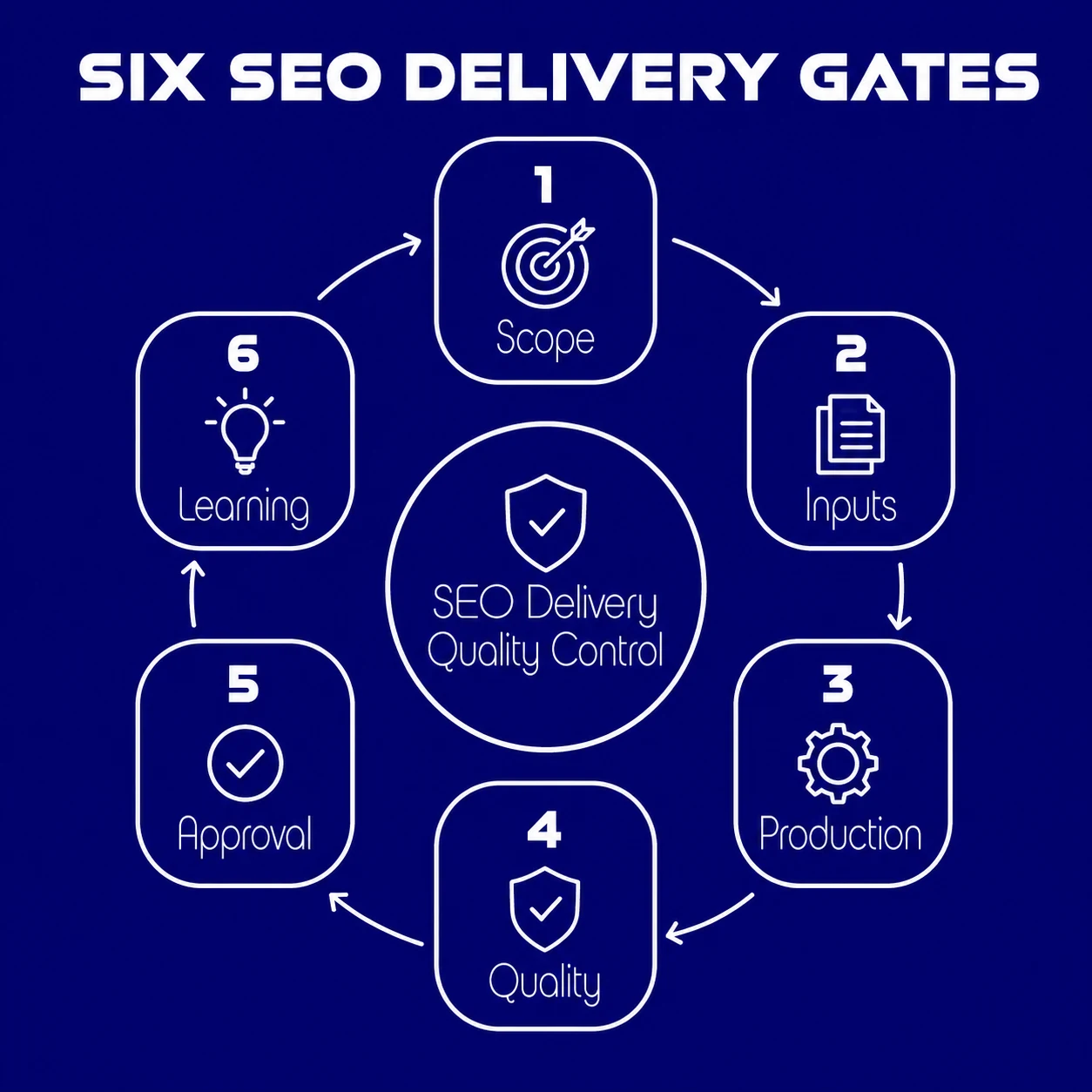
- Scope gate: Define the pages, markets, quantities, exclusions, deadlines, and client responsibilities.
- Input gate: Collect analytics access, brand rules, target pages, previous work, and approval contacts.
- Production gate: Name the tool, operator, checklist, acceptable range, and evidence required for each output.
- Quality gate: Review accuracy, relevance, search intent, technical validity, and policy exposure.
- Approval gate: Record the approver, version, date, and requested changes.
- Learning gate: Compare estimated hours, actual hours, revisions, results, and margin each month.
The formula is SIPQAL (Scope, Input, Production, Quality, Approval, Learning).
A statement of work should define one revision limit and one change-request mechanism. Without those two controls, a fixed-price engagement can acquire new requirements while the fee remains fixed.
Score backlink opportunities before approval
Rate each factor from 0 to 2, require at least 15 out of 20, and reject any opportunity that scores 0 for editorial legitimacy or policy compliance.
| Factor | 0 points | 1 point | 2 points |
|---|---|---|---|
| Topical relevance | Unrelated subject | Broad adjacency | Direct audience and topic match |
| Organic audience | No credible visibility | Limited or declining visibility | Stable visibility for relevant queries |
| Geographic fit | Wrong market | Mixed audience | Target-country audience |
| Editorial legitimacy | Placement exists mainly for payment | Basic review | Clear editorial standards |
| Page value | Thin placement page | Adequate summary | Useful page with specific evidence |
| Outbound-link pattern | Repeated commercial anchors | Mixed pattern | References serve the reader |
| Indexability | Blocked or absent | New or uncertain | Stable indexed page |
| Link attribute | Commercial relationship concealed | Attribute unclear | Attribute matches the relationship |
| Host structure | Suspicious network or irrelevant subdomain | Some uncertainty | Coherent property and ownership |
| Replacement terms | No written remedy | Informal promise | Written replacement conditions |
Google states in its spam policies that paid placements should use rel="sponsored", while nofollow remains an acceptable qualification but it doesn’t allow the passage of link juice/authority to the target link therefore always go for a dofollow (it is alway dofollow if not nofollow). Google’s spam policies also identify low-value content created mainly to manipulate links and rankings as a prohibited mechanism.
A first-hand mistake from a previous workflow
One previous campaign approved a domain without checking the exact subdomain where the backlink would be placed. That mistake led to replacing the placement, spending extra time on verification, and delaying publication because the final page did not meet the agreed requirements.
The exact impact was not recorded, so the figures used here are estimates: 1 replacement placement, about 6 hours of extra work, and a 7-day delay. Replace these estimates with real project records before publishing the case study.
The prevention process now requires five checks before approval:
- Verify the exact hostname rather than the root domain alone.
- Check traffic and ranking data for the relevant host or section.
- Review the proposed article type and surrounding outbound links.
- Confirm the intended link attribute before publication.
- Save the approved URL, screenshot, and criteria in the project record.
A client requesting 10 approved links per month needs more than 10 prospects. When only 25% of reviewed opportunities survive prospecting, publisher response, editorial review, and client approval, the delivery pipeline needs at least 40 viable opportunities before publication delays enter the calculation.
How to start an SEO agency in 90 days
A 90-day launch should prove buyer demand, offer acceptance, delivery quality, and account economics. Each week needs one output and one pass-or-fail gate because completed activity without a decision can consume three months without validating the business.
The 13-week SEO agency launch plan
| Week | Action | Required output | Pass-or-fail gate |
|---|---|---|---|
| 1 | Audit your skills | 20-point readiness score and 2 proof assets | Do not sell broad SEO below 16 points |
| 2 | Interview one buyer group | Notes from 10 conversations | At least 6 buyers describe the same costly problem |
| 3 | Score the niche | Completed 100-point niche matrix | Score at least 70 or conduct more interviews |
| 4 | Define one offer | One-page scope, exclusions, timing, and quantity | A contractor can interpret it without a call |
| 5 | Calculate pricing | Cost model, margin target, and cash requirement | Price includes founder review and revision risk |
| 6 | Build proof | One case study, teardown, or dated experiment | Every result names its data source |
| 7 | Set up operations | Contract, invoice, CRM, project board, and 2 payment routes | Complete one test invoice and payment |
| 8 | Research prospects | 100 accounts with named triggers | Remove accounts without the target problem |
| 9 | Run outreach test 1 | 50 researched contacts | Categorize every reply and objection |
| 10 | Run outreach test 2 | Revised 50-contact batch | Improve fit or change the segment |
| 11 | Conduct sales calls | Qualification notes and proposals | Reject work that requires unpriced delivery |
| 12 | Onboard one client or pilot | Access checklist, baseline, and first sprint | Receive inputs and payment before production |
| 13 | Review the model | Hours, cost, margin, revisions, and pipeline data | Continue only when sales and delivery assumptions hold |
Days 1–30: validate the problem
Ten buyer interviews provide more positioning evidence than 10 untested service pages. Record the same five fields for every interview: problem, current solution, commercial consequence, buying trigger, and objection.
Days 31–60: validate acquisition
A CRM or structured spreadsheet should record every account, contact, trigger, reply, call, proposal, and loss reason. That mechanism turns a failed message into data: poor-fit replies point to the list, confused replies point to the message, and qualified calls without proposals point to the offer or sales process.
Days 61–90: validate delivery economics
The first paid account should record estimated hours, actual hours, external costs, revisions, payment timing, and gross margin. A $2,137 retainer based on the earlier model fails when the account repeatedly exceeds the $1,496 cost allowance.
Stop or change the offer when these four signals appear
- Fewer than 6 of 10 interviewed buyers recognize the problem without coaching.
- Qualified calls repeatedly reject the same condition after the offer has been explained.
- Actual delivery cost exceeds the estimate by more than 20% across two cycles.
- The service depends on a tactic that cannot be disclosed to the client or defended against Google’s published policies.
A stop signal rejects the current mechanism rather than the entire agency idea. The 90-day test earns its value when it prevents a weak service from consuming the next 12 months.
What do founders ask before starting an SEO agency?
How much does it cost to start an SEO agency?
A solo consulting model can begin with first-party tools, a website, project control, and a payment route, while a production model also needs cash for contractors, content, or placements. Use the minimum-retainer formula because the required capital depends on the delivery mechanism rather than one universal startup figure.
Can I start an SEO agency with no experience?
You can begin with a controlled pilot when your scope stays below your 20-point readiness score. Google search central advises clients to request previous work, realistic estimates, measurement methods, and explanations of every planned change, so an untested founder should not sell unrestricted responsibility.
How do SEO agencies get clients?
SEO agencies gain clients through referrals, partnerships, targeted outbound, evidence-led content, and paid acquisition. A new agency should test the first four channels before paid advertising because direct conversations expose problems in the audience, message, and offer without adding media cost.
Is an SEO agency profitable?
An SEO agency can produce a profit when price exceeds delivery, sales, management, software, revision, and tax costs. Promethean Research reported a 13% average after-tax net margin for agencies in 2025, while agencies that reduced services averaged 30%, which shows that focus and cost control materially affect the answer.
What tools do you need to start an SEO agency?
Start with Google Search Console, GA4, one crawler, one project system, one sales tracker, and two payment routes. Add Ahrefs, Semrush, reporting automation, or specialist software only when a paid delivery mechanism requires their data or saves more labour than the subscription costs.
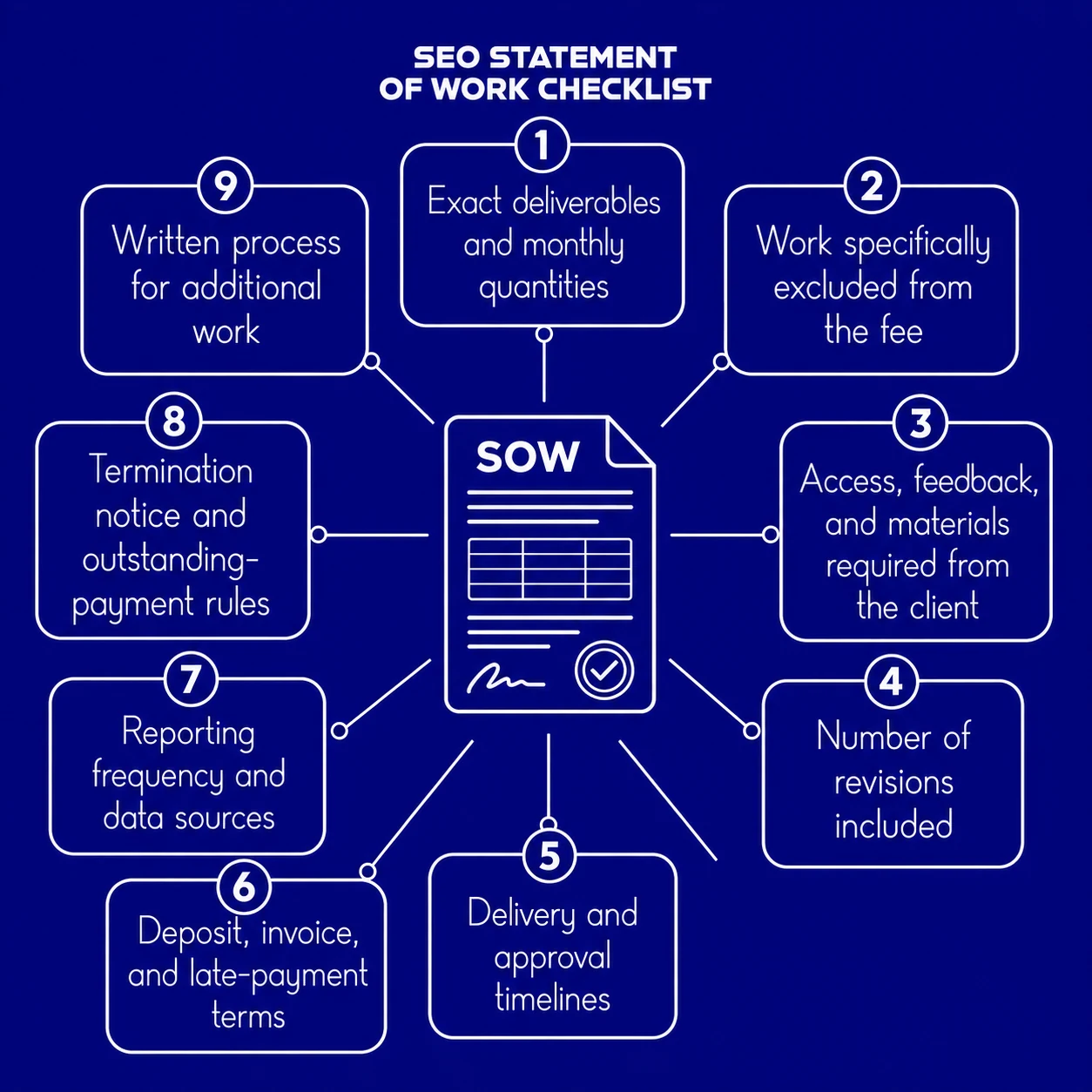
What should an SEO statement of work include?
An SEO statement of work should define the exact outputs, exclusions, client responsibilities, revision limits, timelines, payment terms, reporting schedule, termination terms, and change-request process.
Each deliverable should name its quantity, review standard, deadline, and approval owner.
The exclusions matter as much as the outputs. If development work, content writing, publisher fees, or extra revisions are not included, state that before the contract is signed.
How do you qualify an SEO prospect?
Qualify a prospect before writing a proposal. Confirm the problem, its commercial value, the contact’s decision-making authority, the available budget, required access, expected results, and compatibility with Google’s published policies.
A prospect is weak when the problem has no measurable business impact, the contact cannot approve spending, or the expected outcome depends on guaranteed rankings. A smaller company with clear authority and realistic expectations may be more valuable than a larger company with six approval layers.
| Qualification area | Question to ask |
|---|---|
| Problem | What search problem is affecting the business? |
| Commercial value | What does one additional lead, sale, or booking represent? |
| Authority | Who approves the work and budget? |
| Budget | What monthly range has been allocated? |
| Access | Can the team provide analytics, CMS, and stakeholder access? |
| Expectations | What result and timeframe do they expect? |
| Policy fit | Are they willing to reject manipulative or deceptive tactics? |
What should happen when you onboard your first SEO client?
Client onboarding should establish the scope, payment, data access, baseline, decision-makers, approval rules, and first sprint before production begins. Starting work without those seven items increases delays, revision disputes, and measurement gaps.
First-client onboarding checklist
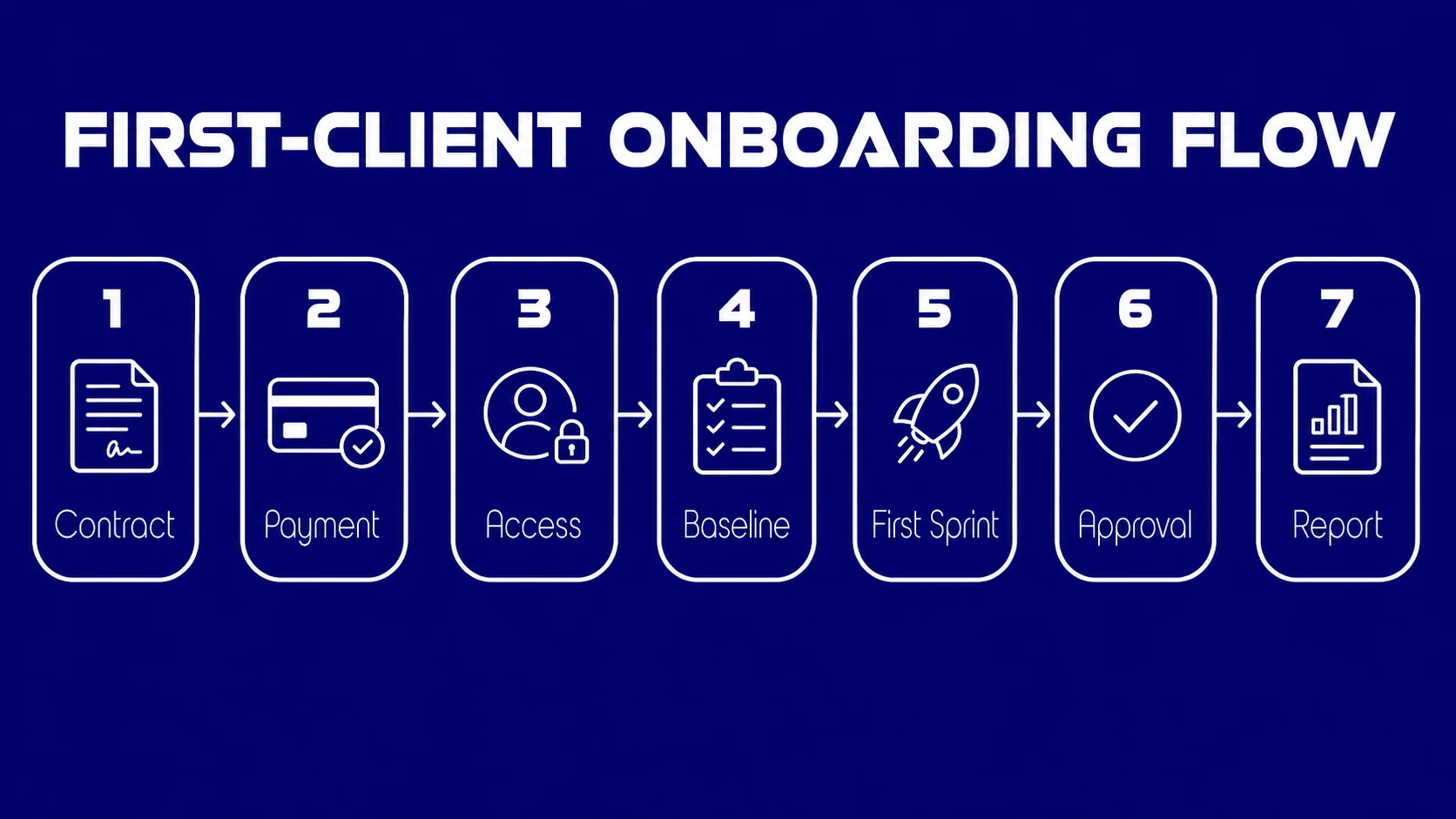
- Receive the signed scope and contract.
- Collect the agreed deposit or first payment.
- Obtain Search Console, GA4, CMS, and other required access.
- Record the ranking, traffic, conversion, and backlink baseline.
- Identify the main stakeholder and final approver.
- Confirm feedback deadlines and approval rules.
- Start the first sprint with named outputs, owners, and dates.
How should an SEO agency plan cash flow?
Cash-flow planning should separate client receipts from delivery obligations. Collect a deposit before production, set shorter client payment terms than contractor or publisher deadlines, and maintain a reserve for replacements, refunds, or delayed approvals.
For example, a client paying in 30 days creates a risk when contractors require payment within 7 days. The agency must finance the 23-day gap unless the contract includes an upfront payment.
Five cash-flow controls
- Collect the first month or project deposit before work begins.
- Keep client payment terms shorter than major supplier deadlines.
- Separate contractor and publisher funds from operating profit.
- Maintain a replacement or refund reserve.
- Pause work after the written late-payment threshold.
A simple reserve can equal one month of external delivery costs. Replace that assumption with actual replacement rates after three to six completed projects.
What should an SEO report contain?
An SEO report should answer five questions: what changed, what happened afterward, what commercial result it affected, what happens next, and what the client must do. A report that only lists rankings and completed tasks does not explain business impact.
| Reporting question | Example |
|---|---|
| What changed? | Five commercial pages received new internal links |
| What happened? | Non-branded impressions increased 18% |
| What did it affect? | Organic demo requests rose from 12 to 16 |
| What happens next? | Update the three pages with the highest impressions |
| What must the client do? | Approve the revised copy by Friday |
Retention improves when the client can connect agency activity with decisions. When results remain flat, explain the mechanism, constraint, and corrective action instead of hiding the problem behind a larger dashboard.
When should an SEO agency hire?
Hiring should follow capacity data rather than founder stress alone. Track maximum active clients, utilisation, review time, contractor quality, missed deadlines, and sales opportunities declined because production is full.
A founder should stop selling temporarily when current clients already consume the available delivery and review capacity. Selling beyond that point converts pipeline growth into late work, weak quality control, and client churn.
Practical hiring triggers
- Founder utilisation remains above 80% for at least four weeks.
- Quality review delays client delivery by more than two working days.
- The same repeatable task consumes at least 20 hours per month.
- At least three months of retained work can fund the role.
- Contractor errors remain measurable and correctable through a checklist.
- The agency is rejecting profitable work because capacity is full.
Hire the production role that removes the clearest repeated constraint. Do not hire a general assistant when technical review, content editing, or prospect qualification is the actual bottleneck.
Which legal requirements should an SEO agency check?
Registration, tax, privacy, contractor agreements, and professional insurance depend on the country and business structure. A founder should confirm local requirements with a qualified accountant, lawyer, or business-registration authority before accepting client payments.
At minimum, review:
- Business registration and permitted trading structure
- Income, sales, or value-added tax obligations
- Privacy rules for analytics, forms, email lists, and client data
- Written intellectual-property and confidentiality terms for contractors
- Professional indemnity or errors-and-omissions insurance
- Record-retention and invoicing requirements
A template written for a United States LLC may not fit a sole proprietor in Pakistan, a UK limited company, or an Estonian private limited company. Use templates as drafting aids, not as substitutes for local advice.
What should you do this week?
Take these first five actions:
- Score your skills using the 20-point readiness test.
- Interview 10 people from one buyer group.
- Choose one problem and one narrow service.
- Calculate the minimum profitable price.
- Build a list of the first 100 qualified prospects.
Do not hire, add more services, or build a large website until those five actions produce evidence that the market, offer, price, and delivery model can work.
Good Luck!
Need a clearer SaaS backlink plan?
If your team does not have the internal resources to manage page selection, prospect qualification, outreach, content, and monitoring, Linkull can first review your priority pages and competitor gaps.