SaaS link building is often managed as a production target: choose a monthly quota, find sites above a certain DR, and keep sending outreach until enough links go live.
That process can produce a respectable-looking report while doing very little for the pages that matter.
The harder and more useful question is not, “How many backlinks can we build?” It is, “Why should another site reference this page?” If the team cannot answer that clearly, outreach is starting too early.
At Linkull, the principle is simple: don’t build the most backlinks; build the right reasons to be referenced.
Focus on valuable pages, strengthen their citation value, and qualify opportunities at the page level.
Then measure post-publication results without assuming every change came from a link.
Google describes links as one signal for discovering pages and understanding relevance, but a backlink does not guarantee higher rankings.
Results also depend on the target page, search intent, competition, internal links, technical SEO, content quality, and other signals.
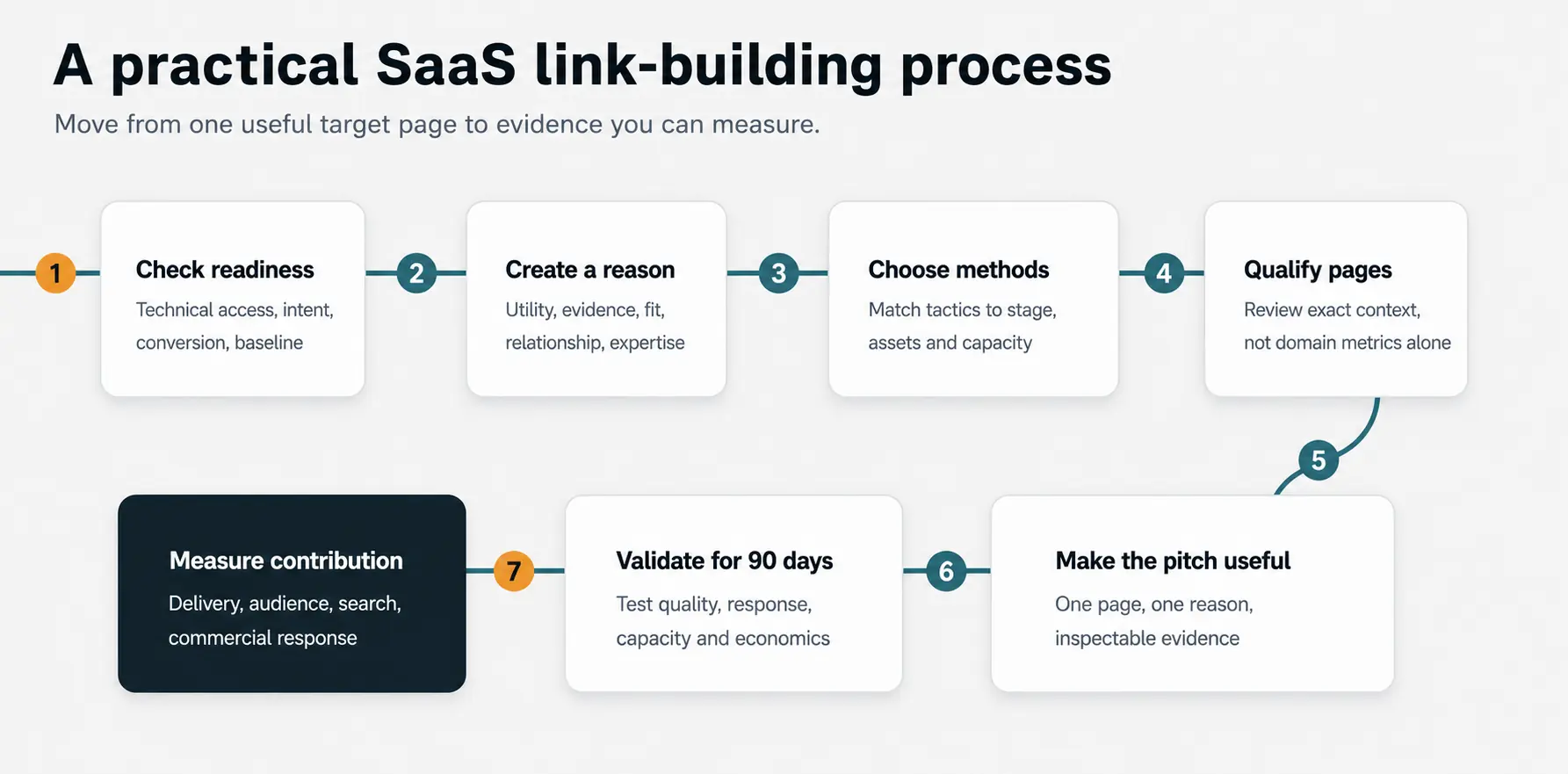
Before outreach begins, a growth team should be able to answer seven questions:
- Is the site ready to benefit from link acquisition?
- Which single page deserves priority?
- What gives a publisher a legitimate reason to cite it?
- Which SaaS link building strategies fit the company’s stage, product, and resources?
- Which exact pages are worth approaching?
- What will the team learn during the first 90 days?
- How will delivery, audience response, search response, and commercial contribution be measured separately?
The rest of this guide works through those decisions in that order.
Step 1: Check readiness before choosing a target page
You can build 100 links to the wrong page and still get nowhere.
A link cannot rescue a page that is blocked from indexing, poorly matched to search intent, hard to use, or incapable of turning qualified visits into a useful next step. It may draw attention to the problem, but it does not solve it.
Run this six-question check before approving a target:
- Can search engines and users reach the page through a stable URL?
- Does the page satisfy the query better than, or the pages already performing?
- Is the next action clear?
- Have search console and analytics been recorded?
- Does the page receive relevant internal links and supporting resource links?
If technical access, intent, or conversion fails, pause the campaign. More prospects will not fix a weak target. Choose the target page without inventing false precision.
Weighted scoring models can be useful when a team has dozens of viable pages. They can also create a misleading sense that a page scoring 74 is meaningfully better than one scoring 71.
Start with two uncomfortable questions:
- If this page gained qualified visibility, could it affect trials, demos, pipeline, retention, activation, or another meaningful goal?
- Does the page give a credible publisher a reason to reference it?
A product page may have high commercial value but little citation value. A benchmark report may be highly citable but sit too far from any business outcome. Neither is automatically the right target.
Sometimes the better route is to build a connected asset
For example, a workflow software company may struggle to earn editorial links directly to its pricing page. A public benchmark on approval delays could attract references, then support the pricing or product page through relevant internal links. The commercial page remains the business target.
That distinction matters. A campaign should know whether it is trying to earn links directly to a money page or earn them to a useful resource that can strengthen a connected part of the site.
Step 2: Create a reason to be cited
Here is the simplest test for a link-worthy page:
Would the publisher still want to reference it if the link provided no ranking benefit?
If the answer is no, the opportunity is probably being held together by an SEO transaction rather than editorial value.
Most defensible links exist for one of five reasons:
- Utility: A tool, template, calculator, API, SDK, integration, or public workflow helps the reader complete a task.
- Evidence: A study, benchmark, dataset, methodology, or documented example supports a claim.
- Product fit: The software belongs in a comparison, category page, implementation guide, or buyer shortlist.
- Relationship: A customer, integration partner, association, or complementary company is documenting a real connection.
- Expertise: A founder, engineer, researcher, or practitioner can clarify a specific issue with verifiable knowledge or experience.
This is where campaigns often go wrong: the team creates a long guide, calls it a “linkable asset,” and assumes length is the reason someone will cite it. It is not. A publisher needs something distinct enough to improve the page they are editing.
A 5,000-word article that repeats familiar advice may be less citable than a one-page calculator with a transparent formula. What matters more is replaceability. If ten other pages offer the same information in the same form, the asset gives an editor a reason to choose yours.
Step 3: Match the method to the company’s stage
There is no universally best backlink strategy. A method can be sensible for one SaaS company and wasteful for another because the available relationships, assets, expertise, and market demand are different.
Use the company’s current position to narrow the field:
- Very early stage: Start with credible ecosystem listings, partner references, founder expertise, and one maintainable utility. Broad digital PR is usually premature unless the company has genuinely newsworthy data or a strong expert angle.
- Bootstrapped: Prioritize warm partners, unlinked mentions, shortlist inclusion, and one reusable asset. Avoid tactics that require constant research, design, and media relations if the team cannot sustain them.
- Growth stage: Support pages already gaining impressions or conversions with research, integrations, partners, selective contributions, and digital PR where the story justifies it.
- Developer-focused: Documentation, SDKs, open-source resources, benchmarks, technical tutorials, and integration examples usually make more sense than generic marketing guest posts.
- Narrow category: Expand into the buyer’s workflow, profession, data problem, or adjacent tools. Do not chase unrelated publications simply because their metrics are high.
The method should fit the reason a link could exist. Guest posting is not a substitute for evidence. Digital PR is not a substitute for a newsworthy story. Broken-link outreach is not useful if your replacement resource does not match what the old source provided.
Step 4: Find and qualify exact pages, not just domains
A list of 500 domains looks productive. A list of 20 exact pages with a defensible reason to link is more useful.
Start with link building opportunities that match the target audience and link mechanism. Useful sources include:
- Pages linking to several relevant competitors.
- Publications citing similar tools, research, or methods.
Customers, integrations, technology partners, and associations. - Category lists, comparison pages, newsletters, and writers covering the problem.
- Unlinked mentions.
- Pages with dead, outdated, or incomplete sources.
For every prospect, record the exact URL, the likely contact, the reason the link could exist, the target page, and the evidence supporting the fit. A domain-level approval is not enough because quality can vary sharply between sections of the same site.
A high DR link can still be a poor placement
Ahrefs defines Domain Rating as a measure of the relative strength of a website’s backlink profile. It does not measure editorial standards, audience alignment, page quality, or legitimacy, and it is not a Google metric.
Imagine a SaaS company choosing between two publications. One has DR 72 but earns most of its visibility from celebrity news and publishes unrelated sponsored posts. The other has DR 48 and consistently ranks for topics used by the SaaS company’s buyers.
The second site may offer the stronger opportunity because the audience, page context, and editorial reason align. DR can help describe a backlink profile. It cannot make that decision for you.
Walk away when you see warning signs such as:
- The delivered hostname or section differs from the approved property.
- The site appears designed mainly to sell links across unrelated categories.
- The page is blocked, deindexed, hidden, or orphaned.
- Unrelated commercial anchors appear throughout the site.
- The publisher guarantees an unqualified paid link for ranking purposes.
- Content is copied or mass-produced mainly to hold outbound links.
- The placement requires a false author, fabricated expertise, or concealed relationship.
Low DR alone is not a spam signal. Declining organic traffic alone does not prove a penalty. Treat metrics as prompts for investigation, not automatic verdicts.
If DR is the only reason you want the link, reconsider the opportunity.
Step 5: Make outreach editorially useful
Most outreach emails do not fail because the subject line lacks creativity. They fail because there was never a good reason to send the email.
- The page fit is weak.
- The wrong person receives the request.
- The proposed addition creates work for the editor.
- The evidence cannot be checked.
- Or the sender asks for a link without explaining what improves for the reader.
A useful outreach email answers four questions before the recipient has to ask them:
- Where does this fit?
- Why does it improve the page?
- Can the recipient verify it?
- What exactly are you asking them to do?
Personalization should come from the opportunity, not from a compliment about the recipient’s “great article.” Refer to the relevant section, the missing evidence, the outdated resource, or the product-selection standard. Keep the request proportionate to the value offered.
Follow up selectively. If the premise remains useful, one concise follow-up may be reasonable. Repeatedly sending the same pitch does not make the fit stronger.
A fictional outreach example:
The email identifies an editorial gap, offers evidence the recipient can inspect, and makes a clear request. SprintBoard and the figures are fictional; they are not Linkull or client data.
Inspect what actually goes live
An approval email is not the result. Once a link is published, inspect:
- The final page and hostname.
- The surrounding paragraph.
- The destination URL.
- The anchor text.
- The link attribute.
- The canonical URL and indexability of the linking page.
- Mobile rendering.
- Any disclosure added to the page.
This is where transparent qualification matters. A placement can change between approval and publication. If the context becomes misleading or the link moves to an unapproved property, reject it or request a correction.
Paid, sponsored, and reciprocal links
Google’s spam policies define link spam as links created primarily to manipulate search rankings. Examples include buying or selling links for ranking purposes, excessive exchanges, automated link creation, and paid advertorial or guest-post links that pass ranking credit.
The relationship should be disclosed, and the publisher should apply the appropriate attribute. Google’s outbound-link guidance explains sponsored, nofollow, and other link qualifications.
Reciprocal links can also be natural between integration partners, customers, associations, and complementary resources. The test is whether each reference helps its own readers. An exchange program built mainly to manufacture ranking is a different thing.
Nofollow and sponsored links may still produce referral visits, branded discovery, and qualified exposure. Do not report a ranking effect simply because the link exists. Measure the audience result instead.
Step 6: Use the first 90 days to validate the process
90 days is long enough to learn whether the targeting, offer, qualification, and operating model are viable. It is not long enough to guarantee a number-one ranking.
| Period | Work | Required output | Stop or change condition |
|---|---|---|---|
| Days 1 to 15 | Readiness audit, baseline, target-page decision, and competitor mechanism analysis | One approved target, rejected targets with reasons, and a measurement baseline | Pause if technical access, intent, or conversion fails |
| Days 16 to 30 | Improve the direct target or build one bridge asset; define qualification criteria; review the first prospects | One credible reference reason and a qualified exact-page list | Change scope if no viable audience or acquisition route remains |
| Days 31 to 60 | Run controlled outreach, pursue warm relationships, and inspect early outcomes | Reply categories, objections, approved pages, live results, and rejection reasons | Change the offer when recipients reject its value, not merely its wording |
| Days 61 to 90 | Continue viable methods, monitor placements, and compare response | Delivery, search, commercial, capacity, and cost review | Scale only if quality, economics, and fit survive review |
Do not interpret a low reply rate in isolation. The cause may be the list, contact, timing, credibility, offer, or target page. Reply categories and rejection reasons are more useful than a single blended percentage because they tell the team what to change.
Four clocks start running when a link campaign begins
“How long until the backlinks work?” sounds like a simple question. It combines four different timelines:
- Acquisition time: Research, editorial review, negotiation, and publication can take days or months.
- Indexing time: A live page may be discovered quickly, slowly, or not at all.
- Search-response time: Visibility can change for many reasons, and it may not change after a link.
- Commercial-response time: Referral visits can appear immediately, while pipeline may lag by the product’s buying cycle.
Inspect new links promptly, review search performance monthly, and judge commercial contribution across the normal sales cycle. A guaranteed ranking timeline hides more than it explains.
Step 7: Measure the result without giving the link all the credit
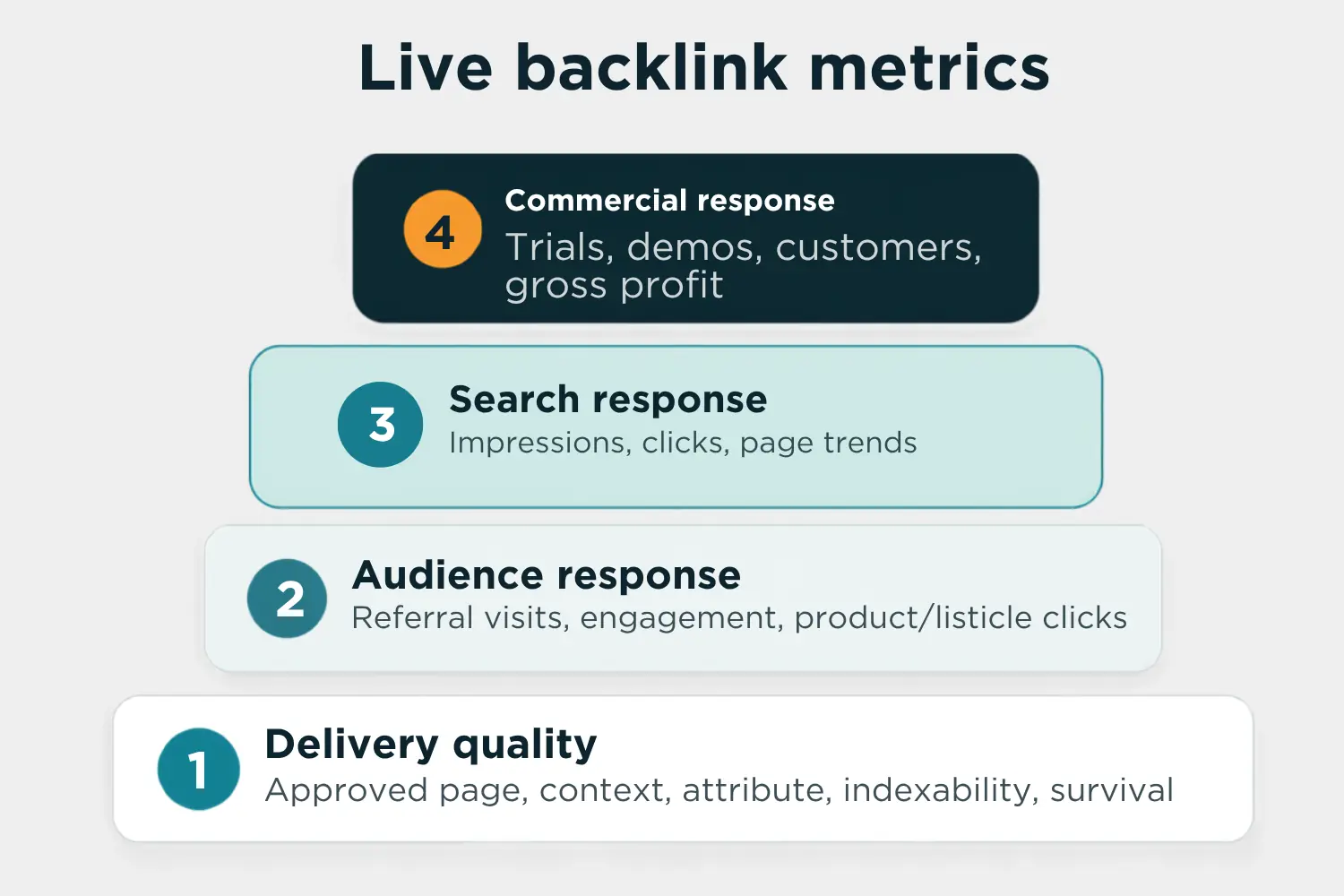
A live backlink proves delivery. It does not prove growth.
The report should separate four layers:
- Delivery: approved pages, links published, attributes, changes, losses, and replacements.
- Audience response: referral sessions, engaged visits, branded searches where observable, and assisted actions.
- Search response: target-page impressions, clicks, average position, query coverage, and internal-page movement.
- Commercial contribution: influenced trials, demos, opportunities, revenue, or another agreed business outcome.
A small team does not need a dashboard filled with metrics. Add a metric only if it can change a decision.
Use attribution without pretending certainty
Content updates, technical work, internal links, seasonality, brand demand, competitor changes, product releases, and search updates can all affect performance. Giving backlinks credit for every positive movement makes the report easier to sell and harder to trust.
A more defensible approach is to:
- Record a dated baseline and annotate link, content, technical, and product releases.
- Compare target pages with similar untreated pages where practical.
- Use Google Search Console for search performance, then analytics and CRM data for user and revenue behavior.
- State the attribution assumption and show conservative, expected, and stronger scenarios where modeling is necessary.
- Replace assumptions with observed evidence as the campaign matures.
This does not produce perfect causal proof. It does stop the team from presenting correlation as certainty.
Calculate break-even before claiming ROI
Linkull’s Link Building ROI Calculator compares conservative, expected, and stronger scenarios while including content and management costs.
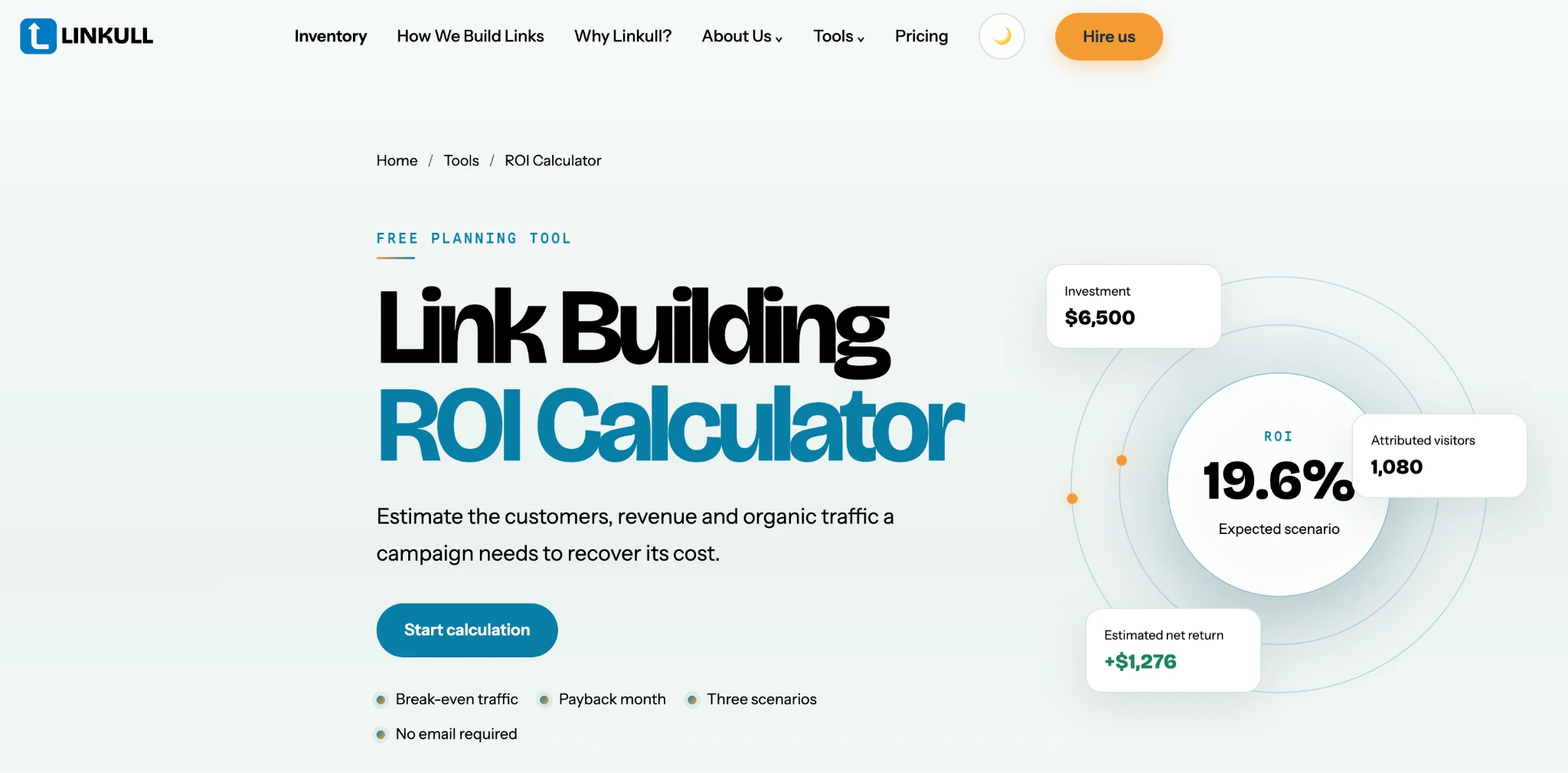
The useful question is not only, “What did each link cost?” It is, “What level of qualified traffic, conversion, or influenced pipeline would make the entire program worthwhile?
Include asset production, prospecting, outreach, publisher costs where applicable, management time, and quality assurance.
If the economics depend on every link producing an immediate ranking increase, the model is too optimistic.
Questions to ask a link-building provider
Do not ask only how many backlinks a provider can deliver. Ask what happens when a placement is poor, changes after publication, or fails the agreed criteria.
Clarify:
- Exact page approval, expected context, and link attributes.
- Policies for paid, sponsored, affiliated, and exchanged placements.
- Rejection criteria and examples.
- Ownership of assets, outreach accounts, revisions, and quality assurance.
- Treatment of changed or lost links.
- Reporting methods and the evidence behind performance claims.
Volume is easy to promise when rejection standards are vague. Transparent qualification should make it possible to understand why a page was approved and why another was refused.
Common SaaS link-building mistakes
Starting with outreach
If the team has not chosen a viable target or created a reference reason, prospecting only scales the confusion. Fix the offer before rewriting the subject line.
Approving domains instead of pages
A reputable domain can contain weak sections, old user-generated pages, sponsored content, or articles with no relevant audience. Inspect the exact page and its place within the site.
Treating DR and traffic estimates as verdicts
Third-party metrics are useful screening inputs, not editorial decisions. Investigate traffic sources, ranking topics, page quality, outbound patterns, and audience fit.
Copying every competitor backlink
Some links come from relationships, acquisitions, private data, legacy activity, or paid arrangements you cannot or should not reproduce. Classify the mechanism first.
Forcing links to commercial pages
Direct links to product and solution pages can make sense in comparisons, integrations, implementation guides, and genuine recommendations. They make less sense in unrelated informational copy. Use a bridge asset when the publisher needs evidence.
Measuring only live-link count
Delivery matters operationally, but it does not answer whether the campaign reached the right audience, supported the target page, or contributed to the business.
Scaling before the process survives review
More outreach magnifies weak targeting, thin assets, and poor quality control. Scale only after the team understands which method works, why it works, and what it costs to maintain the standard.
Do backlinks improve AI visibility?
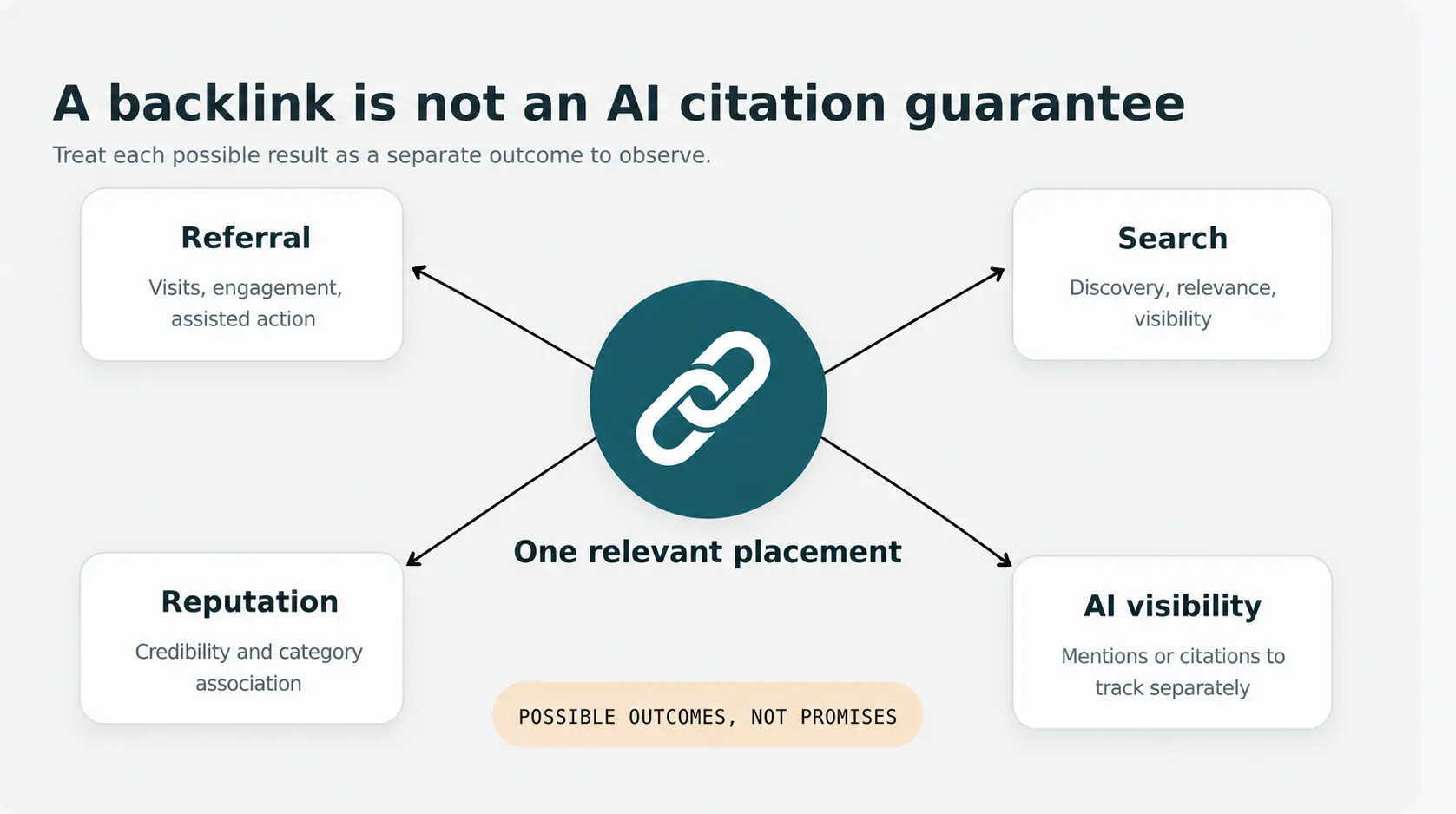
Backlinks do not guarantee citations in ChatGPT, Google AI Overviews, or other AI-search experiences. Buying more links does not create a reliable path to inclusion.
Google’s guidance for AI features says that the same foundational Search requirements apply and that no special AI markup is needed. Crawlable, useful, original content remains the practical focus.
Accurate third-party coverage may support discovery, reputation, referrals, search visibility, or the consistency of information available about a product. A single placement rarely does all of those things at once, and its effect on an AI-generated answer is difficult to isolate.
Keep product information consistent. Publish material that can be checked. Earn accurate references from sources that make sense for the audience. Then measure observable visibility without promising a citation.
FAQs
What counts as SaaS link building?
SaaS link building is the process of earning relevant backlinks to product, solution, comparison, integration, resource, and other high-value pages on a software company’s website. A sound program connects each link to a legitimate editorial reason.
How many backlinks does a SaaS page need?
There is no universal target. The requirement depends on the query, competing pages, existing authority, content quality, internal links, and the kinds of backlinks already supporting the results.
Benchmark pages competing for the same intent, not the entire domains. Use the comparison to understand the gap, then prioritize relevance and placement quality over a fixed quota.
How long do SaaS backlinks take to produce results?
Acquisition, indexing, search response, and commercial response run on different timelines. Review delivery and link quality as placements go live, examine search behavior monthly, and assess business contribution across the product’s normal buying cycle.
Early movement can happen. So can no movement. A few placements are not enough to establish a reliable timeline.
What type of SaaS content attracts backlinks?
Original research, benchmarks, free tools, templates, calculators, technical documentation, integration resources, and genuinely useful guides can all earn links because they give publishers evidence or utility.
The format is secondary. The stronger question is whether the asset solves a real problem or provides information that is difficult to replace.
Are niche edits suitable for SaaS link building?
They can be, provided the existing article genuinely needs the source and the added link improves the reader’s understanding. Evaluate the exact page, surrounding context, organic visibility, outbound-link pattern, and publisher policy.
Avoid insertions that force a commercial anchor into unrelated copy or exist only because the domain has a high metric.
Does guest posting still work for SaaS companies?
Selective guest posting can work when the publication reaches the right audience and the contributor has a useful, credible topic. The article should justify publication without relying on the backlink as its purpose.
Large-scale guest-post programs on unrelated sites create quality, policy, and credibility risks.
Can SaaS companies safely buy backlinks?
Buying links to manipulate rankings creates policy and quality risks. If a placement is paid, sponsored, or affiliated, disclose the relationship and use the appropriate link qualification.
A sustainable program should be able to explain the audience fit and editorial value even when no ranking benefit is assumed.
How can you tell whether link building made money?
Track delivery, topical relevance, referral visits, target-page search visibility, and influenced trials, demos, opportunities, or revenue. Record a baseline, annotate other changes, and state the attribution assumptions.
The result may be influenced rather than directly attributable. Reporting that limitation makes the commercial analysis more credible, not less.
Build around a page that deserves the reference
Linkull supports SaaS and technology teams that have a clear growth target and editorial reason, but limitations to research, qualify, outreach, and inspect placements. Once the target page and measurement plan are set, you can review the backlink placement inventory or contact Linkull.
Conclusion
The strongest SaaS link building programs do not begin with a quota. They begin with a page that matters, a reason another publisher would reference it, and a clear standard for rejecting opportunities that do not fit.
Choose one target. Check its technical, editorial, and commercial readiness. Decide whether the link should point directly to that page or to a connected asset. Then use the acquisition method that matches the company’s relationships, expertise, audience, and capacity.
Relevance beats vanity metrics. Page-level context beats domain-level approval. Transparent qualification beats unexplained volume. And a backlink report should distinguish what was delivered from what the audience, search results, and business did afterwards.
That is the difference between collecting backlinks and building a defensible SaaS SEO program.
Need a clearer SaaS backlink plan?
If your team does not have the internal resources to manage page selection, prospect qualification, outreach, content, and monitoring, Linkull can first review your priority pages and competitor gaps.