Most SaaS link-building campaigns start with a number:
“We need 10 backlinks every month.”
But why 10? Which pages need them? What type of links would help? What happens if those pages still do not rank?
Without clear answers, a monthly link target is only a delivery quota. It may produce a polished report without improving commercial rankings, qualified organic traffic, trials or demos.
A SaaS link-building strategy should determine whether backlinks are actually needed, which pages deserve them, what link building opportunities should be rejected and how results will be measured.
This guide will help you:
- Diagnose whether links are limiting a page
- Select pages based on business value and ranking potential
- Analyse competitors at the page level
- Measure search and commercial outcomes
The goal is not to acquire as many links as possible. It is to direct limited resources toward the pages and opportunities with the strongest strategic case.
What Is a SaaS Link-Building Strategy?
A SaaS link-building strategy is a documented plan that defines which pages need backlinks, why they need them, how those links will be acquired, what quality standards they must meet and how their impact will be evaluated.
A complete strategy includes:
- Business goals and target pages
- Competitor and link gap analysis
- Page readiness and link-building strategy
- Prospect and placement standards
- Budget, team and timeline
- Track results and adjust strategy
If you need the broader fundamentals first, read our practical guide to SaaS link building.
Strategy and tactics are different
A tactic tells you how to acquire a link. A strategy determines whether that tactic makes sense for a particular page and objective.
| Strategy | Tactic |
|---|---|
| Defines goals and priorities | Provides an acquisition method |
| Selects target pages | Finds opportunities for those pages |
| Allocates resources | Executes outreach |
| Establishes quality standards | Produces individual placements |
| Defines success and stopping rules | Supports the wider campaign |
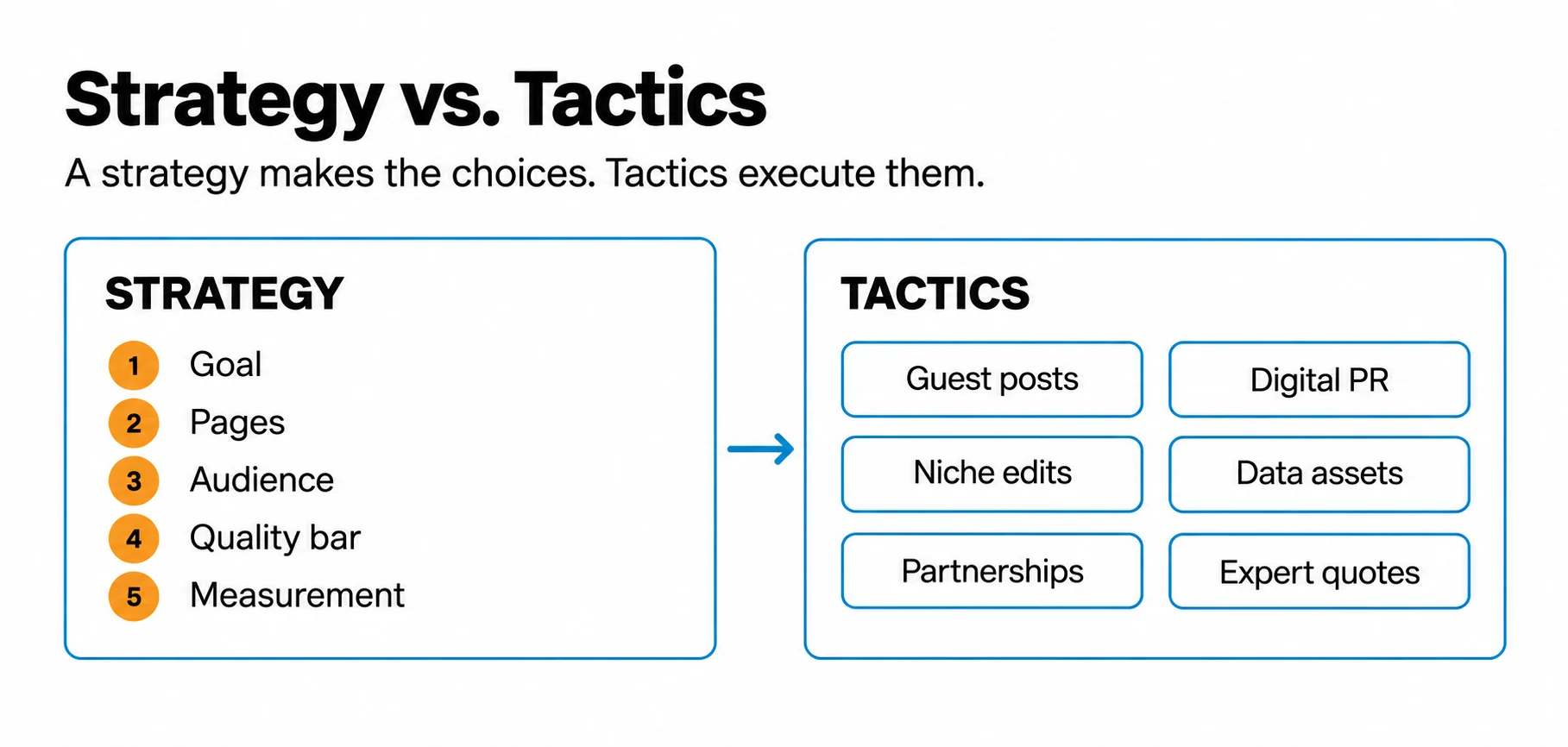
Guest posting, digital PR, link reclamation and partner outreach are tactics. They become strategic only when connected to a target page, audience, competitive gap and measurable outcome.
1. Use the Link-Need Gate Before Approving a Page
An experienced SEO does not assume every ranking problem is a backlink problem.
A page may underperform because it:
- Targets the wrong intent
- Has weak content
- Competes with another page
- Lacks internal links
- Has technical issues
- Has fewer relevant backlinks
Here are the 6 Link-Need Gates:
- Search intent
- Content quality
- Technical health
- Internal links
- Business value
- Competitor link gap
A page should enter active acquisition only after passing all six gates.
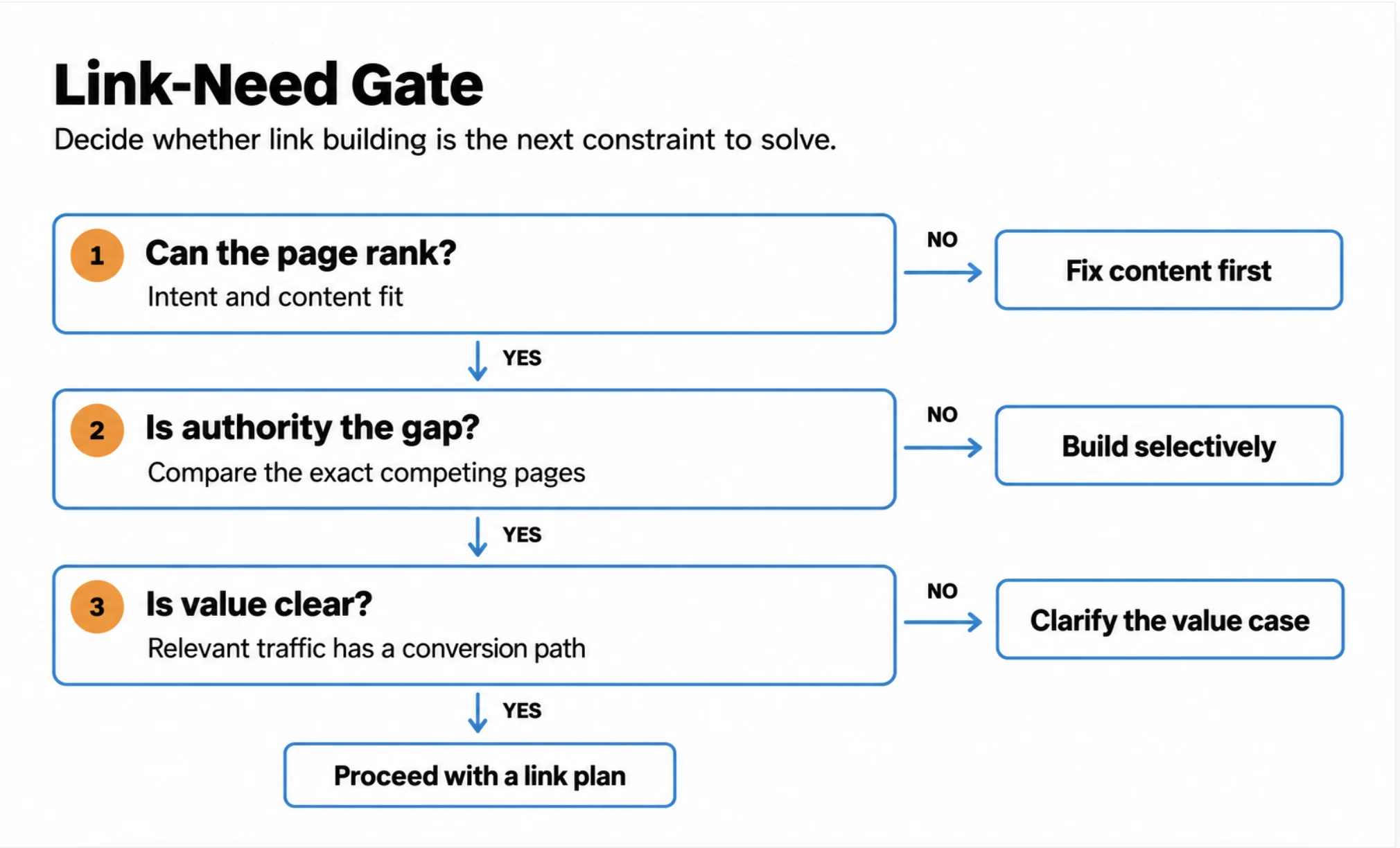
Gate 1: Does the page match search intent?
Search the target query and identify whether the top results are product pages, guides, comparisons, category pages, tools, templates, or directories.
Suppose a project-management platform wants its product page to rank for “how to manage construction projects”. If Google Search primarily returns detailed guides, the query is probably informational.
More links may strengthen the product page without making it the right result. A more suitable plan may be to publish a practical guide, earn links to it and connect it to a relevant product or use-case page through contextual internal links.
Links can strengthen a suitable page. They cannot reliably turn the wrong page type into the right search result.
Gate 2: Is the content competitive?
Do not judge this by word count.
Instead ask:
- Does the page answer the main question quickly?
- Does it cover the decisions readers need and offer product evidence?
- Can a qualified visitor understand the next step?
A 3,000-word page can remain weak if it avoids the reader’s actual problem. A shorter page can be stronger if it provides the right answer, evidence and next step.
Google’s people-first content guidance is a useful reference here. The page should exist primarily to help its intended audience, not merely to attract search traffic.
Gate 3: Is the page technically ready?
A technically ready page always:
- Loads successfully
- Is indexed and rendered
- Has the correct canonical URL
- Is linked internally
- Has working tracking
Use Google Search Console’s URL Inspection report to check how Google sees the page. A crawler can also help identify broken internal links, orphan pages, conflicting canonicals and redirect chains.
Do not build links to a URL that is blocked, duplicated, or scheduled for replacement.
Gate 4: Does the page have internal-link support?
Before building external links to an important page, check that relevant internal pages link to it using natural, descriptive anchor text. Keep it easy to reach within your site structure and link it to useful supporting resources.
Your own website should make the page’s importance clear.
Gate 5: Can the page produce business value?
A high-volume keyword is not always a valuable target. You should ask what a relevant visitor can do after landing. Whether it:
- Begin a trial
- Request a demo
- Compare the product
- Evaluate a feature
If improved visibility would not support a commercial or strategic objective, the page should not receive priority simply because it can attract traffic.
Gate 6: Does a link gap remain persistent?
Compare the exact ranking URLs and their relevant referring domains.
If your page passes the above mentioned six gates but has substantially weaker link support than competing pages, external authority is more likely to be a meaningful constraint.
Use Linkull’s campaign readiness checklist to document these checks before outreach begins.
2. Define the Outcome Before Choosing a Link Target
“Build more authority” is not measurable. Choose one clear goal:
| Business outcome | SEO objective | Likely target pages |
|---|---|---|
| More demos | Improve high-intent visibility | Product, industry and use-case pages |
| More trials | Attract qualified non-branded traffic | Feature, solution and template pages |
| Category entry | Build authority around the category | Category page, research and supporting content |
| Comparison visibility | Rank during product evaluation | Alternative and comparison pages |
| Integration adoption | Improve ecosystem discovery | Integration and partner pages |
If the goal is more demos from finance teams, a general productivity article may attract traffic without supporting the objective.
Record a baseline
Before acquiring links, record the page’s:
- Rankings, impressions, and clicks
- Organic traffic and conversions
- Relevant referring domains
- Internal links
- Competitor performance
Use the Search Console Performance report for first-party data about clicks, impressions, click-through rate and average position.
Use GA4 or another analytics platform to evaluate on-site behaviour, and CRM data where available to track qualified leads and pipeline.
3. Reject Pages Before Prioritizing Them
A SaaS website may have dozens of pages it wants to rank. They do not all deserve immediate link investment.
Group potential targets into:
- Homepage
- Product, feature, use-case, and integration pages
- Comparison and alternative pages
- Research, tools, and templates
Reject or postpone pages with mismatched intent, duplicate targeting, low value or demand, weak content, poor conversion potential, technical issues, or a short lifespan.
Use the Priority Page Score
Score the remaining pages from 1 to 10 across five factors.
| Factor | Question | Weight |
|---|---|---|
| Business value | Would better visibility support a meaningful outcome? | 30% |
| Ranking opportunity | Is there evidence the page can compete? | 25% |
| Link gap | Do ranking pages have stronger relevant link support? | 20% |
| Page readiness | Is the page strong enough to benefit? | 15% |
| Linkability | Is there a credible route for earning links? | 10% |
Calculate:
What does this look like in practice?
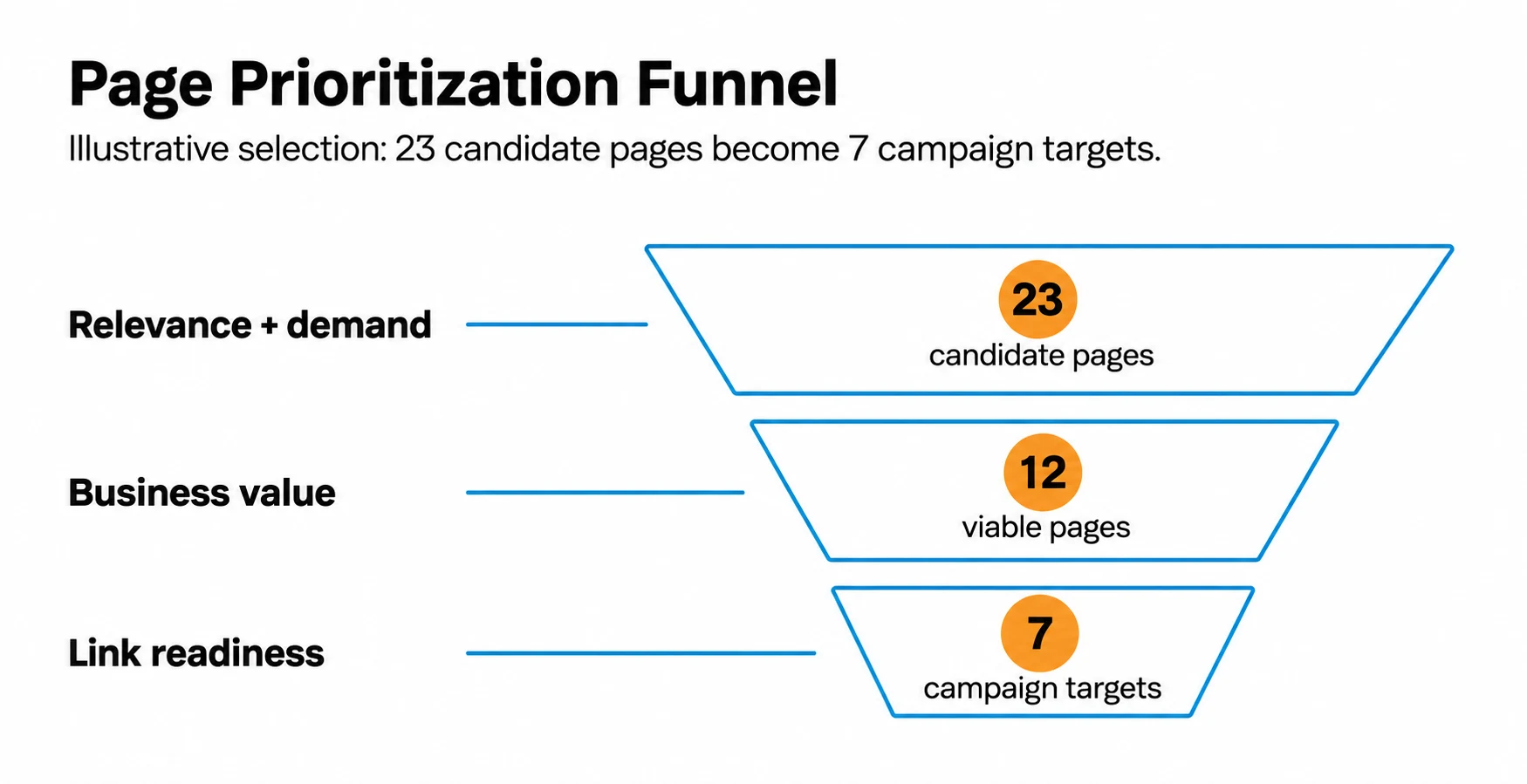
In one of Linkull's link building campaigns, target-page prioritization reduced 23 submitted URLs to seven active targets.
The campaign reviewed 360 prospective websites, qualified 104, acquired 26 referring domains, and moved five priority URLs into the top 10 during the measurement period.
The campaign also included page and internal-link improvements, so it would be inaccurate to attribute every change to backlinks alone.
4. Analyse Search Competitors at the Page Level
Your commercial competitors may differ from your search competitors. A product page can compete with SaaS companies, review sites, industry publications, marketplaces, free tools, and educational resources, so always analyse the exact URLs ranking for each target query.
What should you compare?
Use Ahrefs, Semrush or a similar platform to review:
- Referring domains and their relevance
- Linking-page visibility and context
- Internal links
- Content quality and search intent
- Domain strength
- Link-attracting assets
Focus on referring domains rather than raw backlink totals as a starting point. One domain can generate hundreds of backlinks through navigation, templates, syndication or scraped pages.
Remember, Referring-domain counts still require manual review.
A documented backlink-gap analysis can help organize competitor opportunities, but the exported domains still need relevance and quality checks.
Look for patterns, not links to copy
A competitor profile may include:
- Strong editorial citations
- Old directory listings
- Sitewide links
- Weak or paid placements
Instead of copying every source, identify the patterns why the pages earn links.
Such patterns may include:
- Original data cited by journalists
- Tools included in relevant comparisons
- Templates referenced by educators
- Founders quoted as specialists
- Research used as a source
A page-level authority gap can justify focused acquisition when the target page is already relevant, ready and close to competing.
A separate Linkull case study shows why backlink distribution may matter more than the total number reported for a domain.
How many links might the page need?
Suppose your page has eight relevant referring domains. Ranking competitors have 15, 19 and 25.
The requirement is not automatically 7 to 17 more links. Instead you should ask:
- Are competitor links relevant and editorial?
- Do linking pages have real visibility?
- Are competitor domains stronger?
- Is your content or internal linking better?
- Are competitors established brands?
Use the numerical gap as a directional benchmark, not a purchase quantity.
5. Choose the Route Through Which Authority Will Reach the Page
Route 1: Direct acquisition
Build links directly to the commercial page when it naturally belongs in:
- Product comparisons
- Integration resources
- Partner pages
- Industry discussions
For example, an accounting publication comparing financial-reporting platforms may reasonably link to a relevant product page.
The same link inserted into an unrelated productivity article would have weak contextual fit.
Route 2: Asset-led acquisition
Use a supporting asset when the commercial page lacks a strong citation reason.
Linkable assets include original research, industry benchmarks, calculators, templates, statistics pages, technical resources, and data-led case studies.
The route works like this:
- Create something publishers have a reason to reference.
- Earn editorial links to it.
- Add relevant internal links to commercial pages.
- Measure whether those commercial pages gain visibility.
The asset and commercial page must be topically connected. A highly linked statistics page will not automatically support every product page on the domain.
Route 3: Mixed acquisition
Use direct links where the product deserves a recommendation and asset-led links where information provides the stronger citation reason.
Most SaaS campaigns need this balance. Forcing every placement toward a money page can weaken editorial fit. Sending every link to informational content can leave important commercial pages unsupported.
6. Match Acquisition Methods to Available Advantages
| Available advantage | Acquisition method |
|---|---|
| Awareness regarding your product | Research led digital PR |
| Get free links to your target pages | Resource outreach |
| Linking to the existing unlinked coverages | Brand-mention reclamation |
| Get recommended by the subject specialists | Expert contributions |
| Link to the relevant outdated resources | Broken-link building |
| Strong industrial relationships | Case studies |
Remember, Digital PR without original data or a credible story often becomes generic commentary.
Guest posting can work when the publication serves a relevant audience and the contribution contains real expertise. It becomes weak when interchangeable content is created solely to carry an anchor.
A niche edit can be reasonable when an editor adds a genuinely useful resource to an existing page. It becomes questionable when an unrelated commercial link is forced into an old article because that URL has authority.
Explore the wider set of link-building strategies after deciding which pages and assets the campaign can credibly offer.
7. Evaluate Backlinks With the RECAP Framework
“Build high-quality backlinks” is incomplete advice.
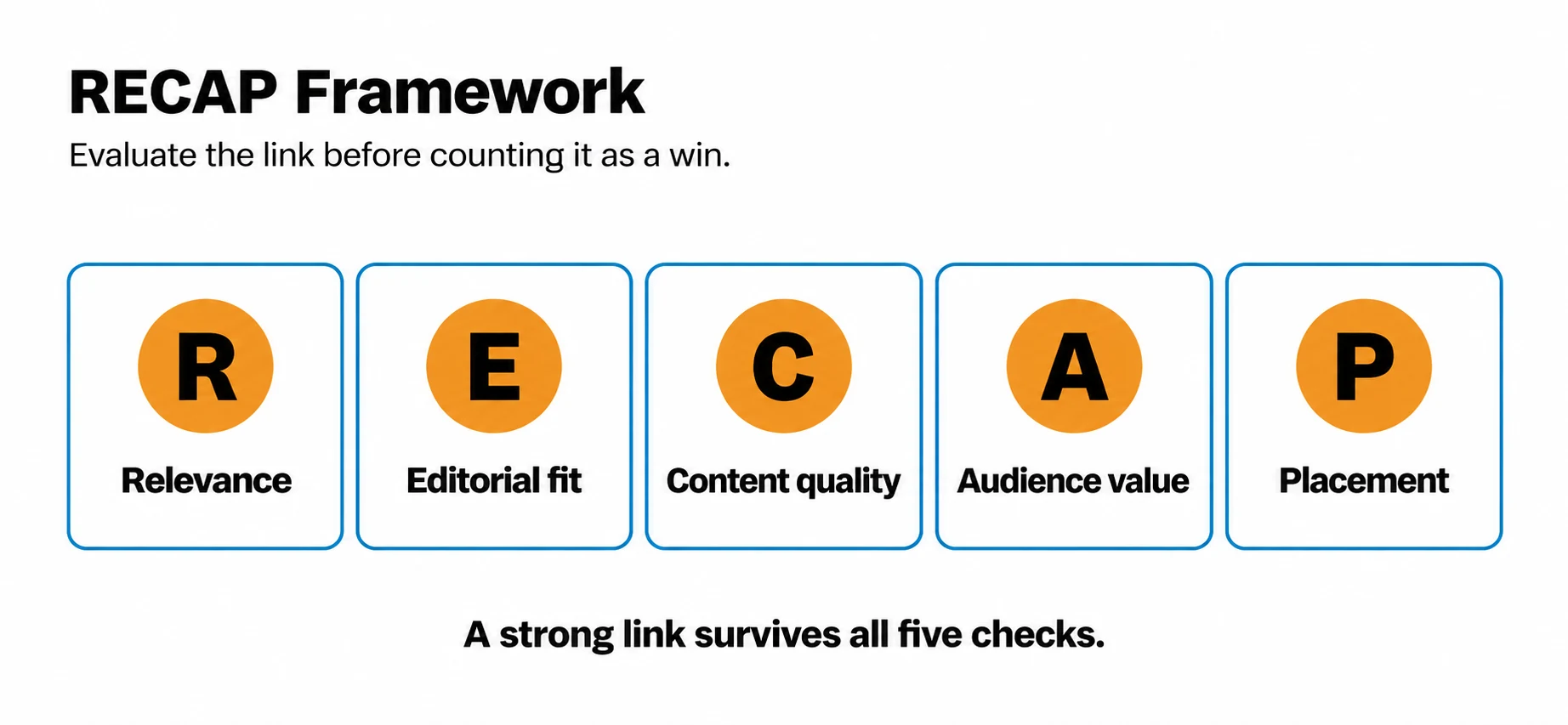
A useful backlink depends on the relationship between the source, linking page, audience, placement and destination.
The RECAP Framework evaluates five factors:
- Relevance
- Editorial quality
- Context
- Audience fit
- Page visibility
Relevance
Review relevance at three levels:
- Website: Does the domain regularly cover the industry or problem?
- Page: Is the linking article related to the destination?
- Section: Does the link make sense in the surrounding discussion?
Broad domain relevance is not enough when the specific page is unrelated.
Editorial quality
Ask:
- Is the content written for a real audience?
- Are authors and ownership identifiable?
- Does the website publish unrelated sponsored topics at scale?
- Would the page deserve to exist without its commercial links?
A page created mainly to host links can satisfy a metric threshold while failing editorial review.
Context
Classify the reason for the link:
- Editorial citation
- Product recommendation
- Digital PR coverage
- Partner relationship
- Niche edit
The method alone does not determine quality. The link should improve the section in which it appears.
Audience fit
Would the publication’s readers reasonably care about the destination?
A specialized audience of finance managers may be more valuable to a financial-reporting platform than a much larger consumer audience.
Referral traffic does not need to be large to be relevant.
Page visibility
Do not rely only on domain-wide organic traffic.
Check whether the linking page:
- Is indexed
- Receives internal links
- Ranks for relevant terms
- Is accessible within the site
New or specialist pages can still be valuable without substantial estimated traffic. Visibility should inform the decision, not act as an automatic threshold.
Why Domain Rating is not enough
Domain Rating is Ahrefs’ proprietary measure of backlink-profile strength. Semrush uses its own authority score.
Google does not use either third-party metric as its own ranking score.
Consider two hypothetical opportunities for a financial-reporting platform:
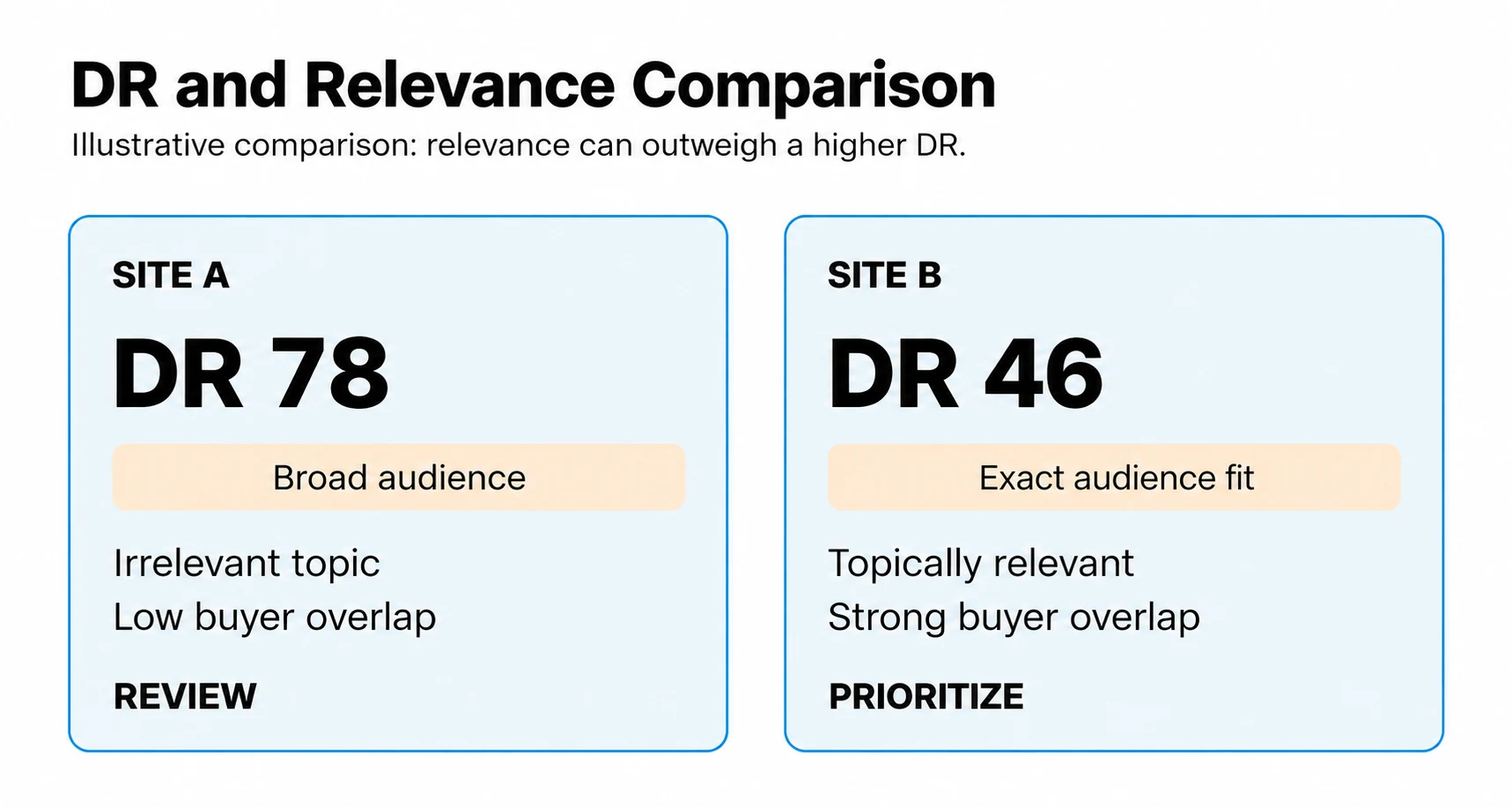
Website A raises the average DR in a report.
Website B may be more useful because its topic, audience, context and destination align. That does not guarantee ranking impact, but it gives the link a more defensible reason to exist.
Use the backlink value estimator to compare relevance, visibility, placement, risk and price without allowing DR to dominate the assessment.
What kind of backlink opportunities should be rejected?
Reject or investigate further if:
- The site publishes unrelated sponsored content
- Its whole purpose of existence is to provide backlinks
- Its audience is irrelevant
- The link would be poorly placed
- The link would not help readers
Google’s spam policies provide a useful policy reference for manipulative linking practices.
Paid placements should also be appropriately qualified under Google’s paid-link guidance.
What kind of anchor text should be used?
Choose anchor text based upon the sentence and destination.
Natural types include:
- Brand/Product names
- Page titles
- Contextual phrases
- Partial-match descriptions
Don’t force every publisher to use the target keyword. An artificial exact-match percentage is not a substitute for natural editorial language.
8. Calculate the Resources Behind the Target
A target of 10 links doesn’t mean finding 10 websites.
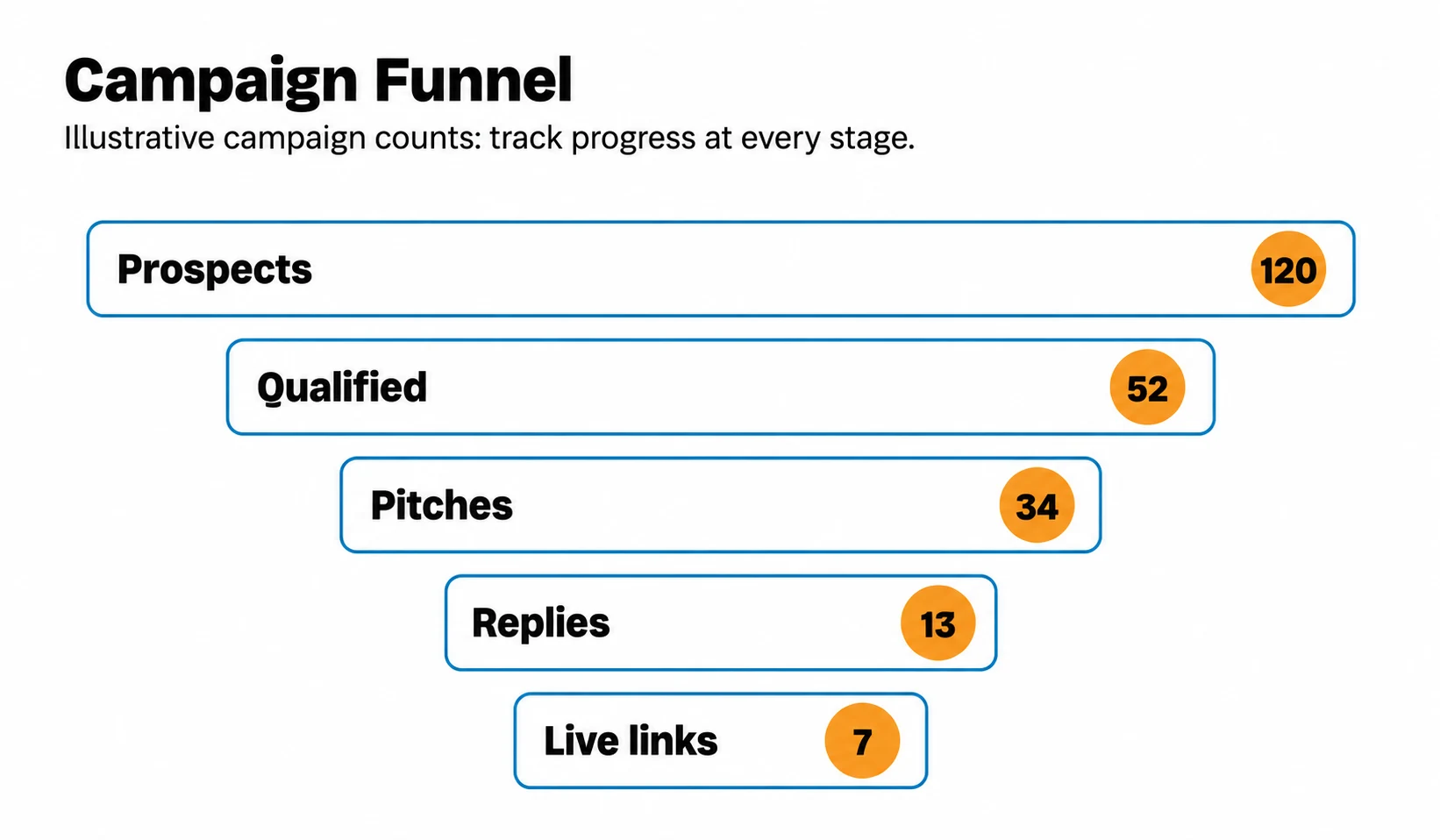
The most critical part is calculating the cost of strategy before executing and then optimizing it. Here is our full guide on the cost of link building.
9. Build a 90-Day Execution Plan
A 90-day plan creates a repeatable operating cycle. It does not guarantee rankings within three months.
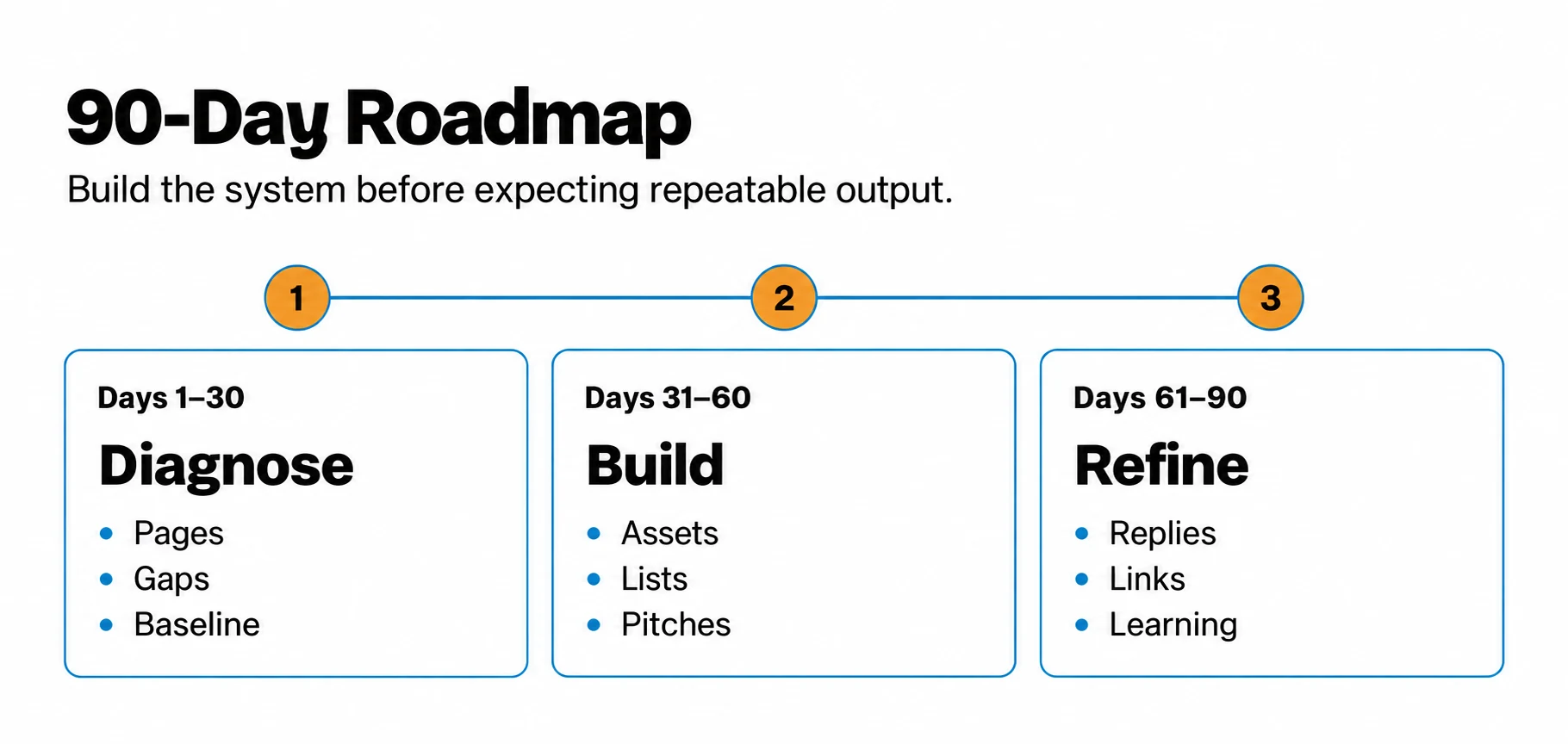
Days 1 to 30: Diagnose and prepare
- Define the business outcome
- Apply the Link-Need Gate
- Reject unsuitable URLs
- Analyse ranking competitors
- Choose authority routes
- Define RECAP standards
- Prepare assets and outreach angles
Output: An approved strategy with campaign ready pages.
Days 31 to 60: Launch and validate
- Build prospect lists
- Test outreach angles
- Launch selected methods
- Secure initial placements
- Inspect publish pages
Output: Evidence showing which targeting and outreach combinations work.
Days 61 to 90: Refine and scale
- Compare acquisition methods
- Improve weak funnel stages
- Review target-page visibility
- Strengthen internal links
- Plan the next cycle
Output: A campaign model revised using evidence instead of assumptions.
10. Measure Results With the Outcome Ladder
A live-link report answers what was delivered. It does not show whether the strategy worked.
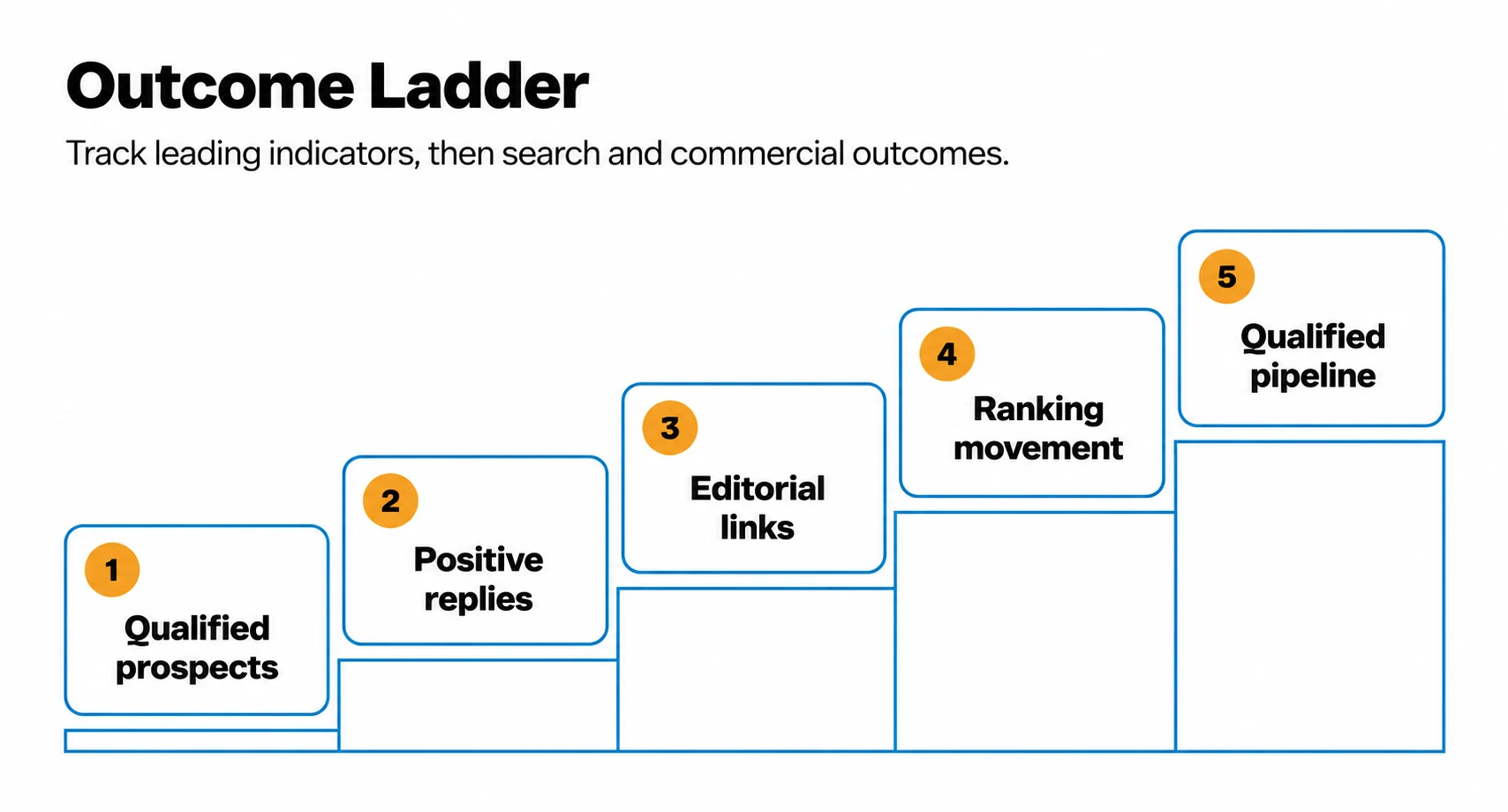
- Link delivered
- Link discovered
- Search visibility changes
- Qualified traffic changes
- Business outcomes change
Level 1: Delivery
Confirm that the link points to the correct page, uses natural anchor text, appears in the agreed location, has the right attribute, and is accessible.
Level 2: Discovery
Check that the linking page is indexed, remains live, is detected by monitoring tools, and can be accessed by search engines.
Level 3: Search Visibility
Use Google Search Console and a consistent rank tracker to monitor rankings, top-10 keywords, non-branded impressions and clicks, and competitor visibility. Interpret average position carefully because query, location, device, and search features can affect it.
Level 4: Qualified Traffic
Use GA4 to track organic sessions, engaged visits, movement to feature or pricing pages, trial starts, and demo submissions. Traffic matters only when it reaches the right audience.
Level 5: Business Contribution
Where possible, measure trials, demo requests, product-qualified leads, assisted conversions, influenced pipeline, and organic customer acquisition.
Configure meaningful actions as GA4 key events or track them through an equivalent analytics and CRM setup.
See how Linkull used paid-search evidence to prioritize pages and increase organic SaaS leads.
11. Continue, Correct or Pause
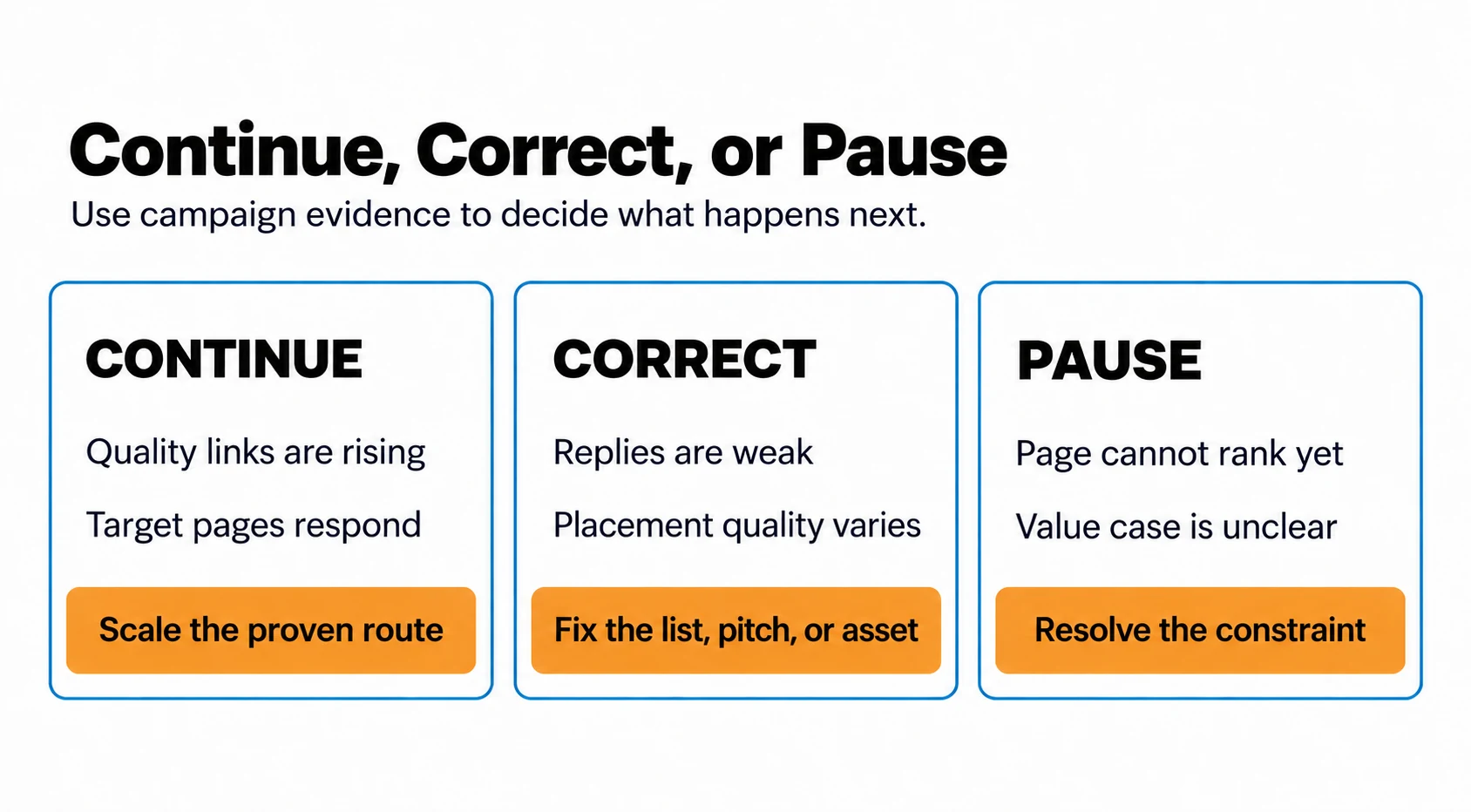
Every review should end with a decision.
Continue when:
- Placement quality remains consistent
- Priority pages show useful visibility signals
- Acquisition cost remains acceptable
- The supported pages remain commercially relevant
Correct when:
- Outreach responses are weak
- Links grow but rankings remain flat
- Assets gain links but commercial pages do not improve
- Rankings rise but conversions remain weak.
Possible corrections include:
- Improving the target page
- Changing the outreach offer
- Strengthening internal links
- Reducing active target pages
Pause when:
- Search intent changes
- The URL will be replaced
- Technical issues prevent stable indexing
- Acquisition cost exceeds realistic value
Consistency is valuable only while the underlying decision remains valid.
Limitations and Risks
Link building supports search performance but cannot guarantee rankings, traffic or AI citations. Results also depend on competitors, content, internal links, technical SEO and brand demand. Algorithm changes, link discovery and search results features can also affect.
Ahrefs and Semrush provide estimates, not Google’s internal authority or traffic data. Their metrics help assess trends but cannot prove a backlink caused a specific improvement. Even Google Search Console cannot separate one link’s impact from every other change.
Report published links first, followed by changes in target-page performance and relevant traffic. Then document commercial outcomes and other work completed during the same period. This provides stronger evidence than attributing precise ranking or revenue gains to one link.
Frequently Asked Questions
When should a new SaaS company start building backlinks?
Start when the website has stable, indexable pages that match search intent and provide a clear next step. Early acquisition can support authority, but it should not take priority over weak positioning, content, technical problems or unclear keyword targeting.
Should SaaS backlinks point directly to product pages?
Link to product pages when they fit a comparison, recommendation, integration or industry discussion. When a direct link feels forced, earn backlinks to useful content, tools or templates. Connect these resources to commercial pages through contextual internal links.
How often should the strategy be reviewed?
Review execution monthly and reassess the broader strategy every 60 to 90 days. Review sooner if search intent changes, a target page is replaced, placement quality declines or commercial priorities shift.
Is it better to manage link building internally or use an agency?
In-house execution works when the company has experience, content capacity, relationships and time for quality control. External support can help when the strategy is clear but acquisition exceeds internal capacity.
Can backlinks improve visibility in AI answers?
Relevant third-party coverage may increase the number of credible sources discussing a company, but backlinks do not guarantee citations in ChatGPT, Google AI features, Perplexity or other systems.
Google’s AI search guidance continues to emphasize the same foundational Search requirements rather than a special AI-only optimization method. Track AI mentions separately and focus on accurate information, original evidence and useful coverage.
Build Fewer Links With Clearer Reasons
A SaaS link-building strategy should not begin with a monthly quota.
First determine whether backlinks are actually the constraint. Reject pages that are not ready. Concentrate resources on commercially valuable URLs with realistic ranking opportunities. Qualify websites using relevance, editorial quality, context, audience fit and page visibility.
Then measure what changes.
Start by listing every page being considered for acquisition. Remove any page that fails on search intent, readiness, business value or conversion potential. Build the campaign around the pages that survive.
If your team can execute the plan internally, use the frameworks in this guide to control quality and measure progress.
If you need help identifying the pages and authority gaps worth investing in, book a free backlink audit. We’ll review the target pages, competing URLs and backlink profile before suggesting the next step.
Want a clearer SaaS link-building plan?
We’ll review your target pages, competing URLs and backlink profile before suggesting the next step.