The real problem is not finding another tactic
SaaS link building strategies are repeatable ways to earn relevant backlinks that help software companies get discovered and chosen. Links are one part of SaaS SEO, so the page, search intent, technical foundation, and measurement plan still matter.
Most SaaS teams do not have a link-building idea problem. They have a prioritization problem. It is easy to list common SaaS link-building strategies: publish guest posts, run digital PR, create a free tool, find broken links, and contact websites linking to competitors.
The difficult questions come next:
- Which page should receive the link?
- Is the referring website genuinely useful or simply carrying a high DR?
- Will the placement help rankings or only improve a report?
- How much should the campaign cost?
- How will you know whether it contributed to leads?
This guide answers those questions. But more importantly, it explains when to use them, what to reject, and how to connect SaaS backlinks to meaningful outcomes.
For the broader process behind campaign planning, see Linkull's practical SaaS link-building guide.
Decide what your backlinks need to achieve
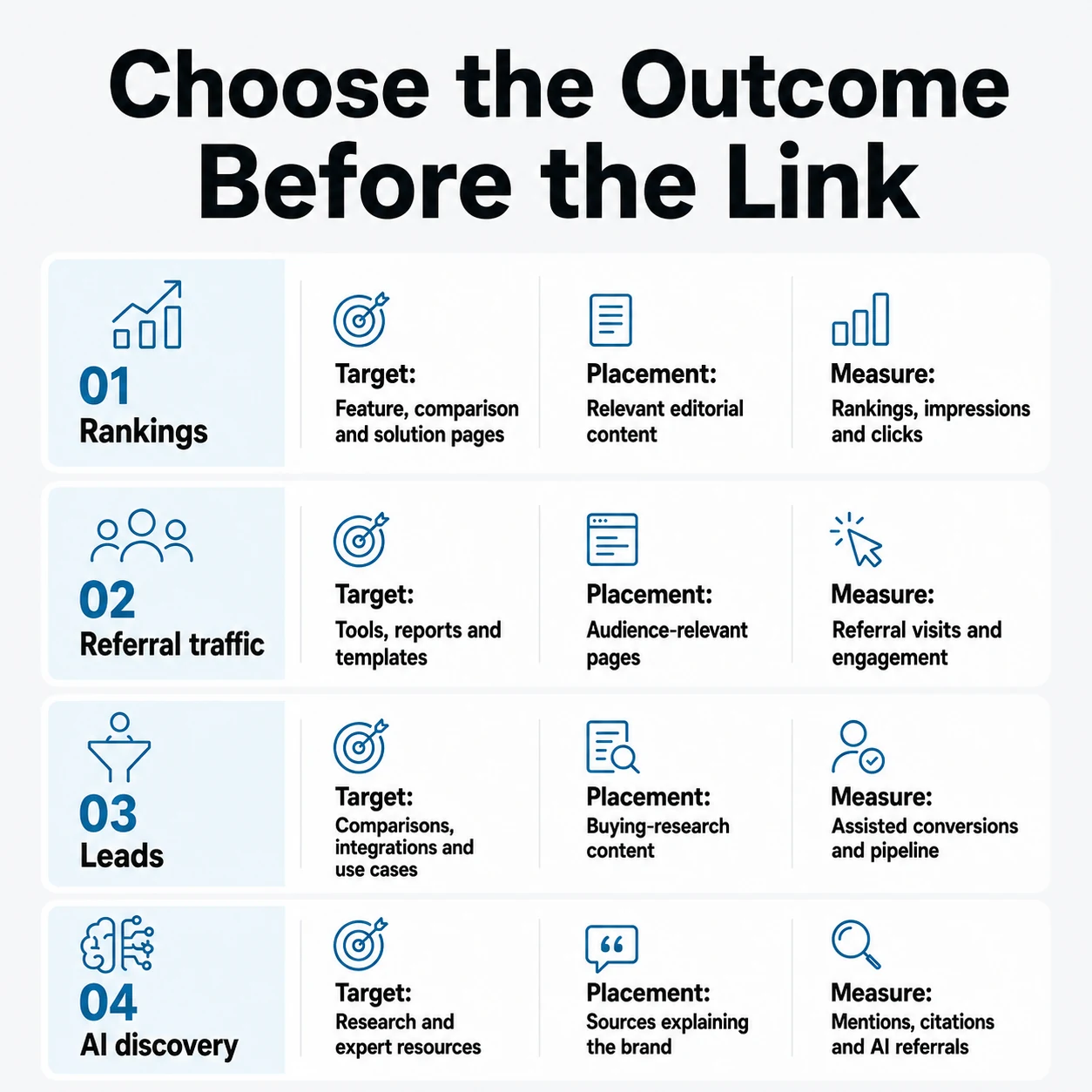
You can't properly evaluate a backlink until you know what it is supposed to accomplish. One link may support several outcomes, but one outcome should lead the decision.
| Objective | Suitable targets | Placements to prioritize | Main measurement |
|---|---|---|---|
| Rankings | Feature, comparison, solution, and high-potential content pages | Relevant editorial links supporting the target topic | Query-level rankings, impressions, and organic clicks |
| Referral traffic | Tools, reports, templates, and educational resources | Pages already receiving traffic from the intended audience | Referral visits and engagement |
| Leads | Product comparisons, integrations, use cases, and commercial resources | Pages used during buying research | Assisted conversions and qualified pipeline |
| AI discovery | Original research, expert resources, and clear brand references | Sources that explain what the company does and when it is relevant | Tracked mentions, citations, and AI referral traffic |
Practical example: A specialist workflow-automation publication may have a lower DR than a broad business website. If the specialist publication reaches operations teams and provides natural editorial context, it may offer better relevance, referral potential, and commercial value.
How to evaluate a SaaS backlink’s quality
Domain Rating can help compare backlink profiles inside Ahrefs, but it is a third-party metric, not a score used by Google. Ahrefs describes DR as a measure of backlink-profile strength, which makes it a useful filter rather than a final verdict.
A useful way to evaluate an opportunity is the domain-page-placement test.
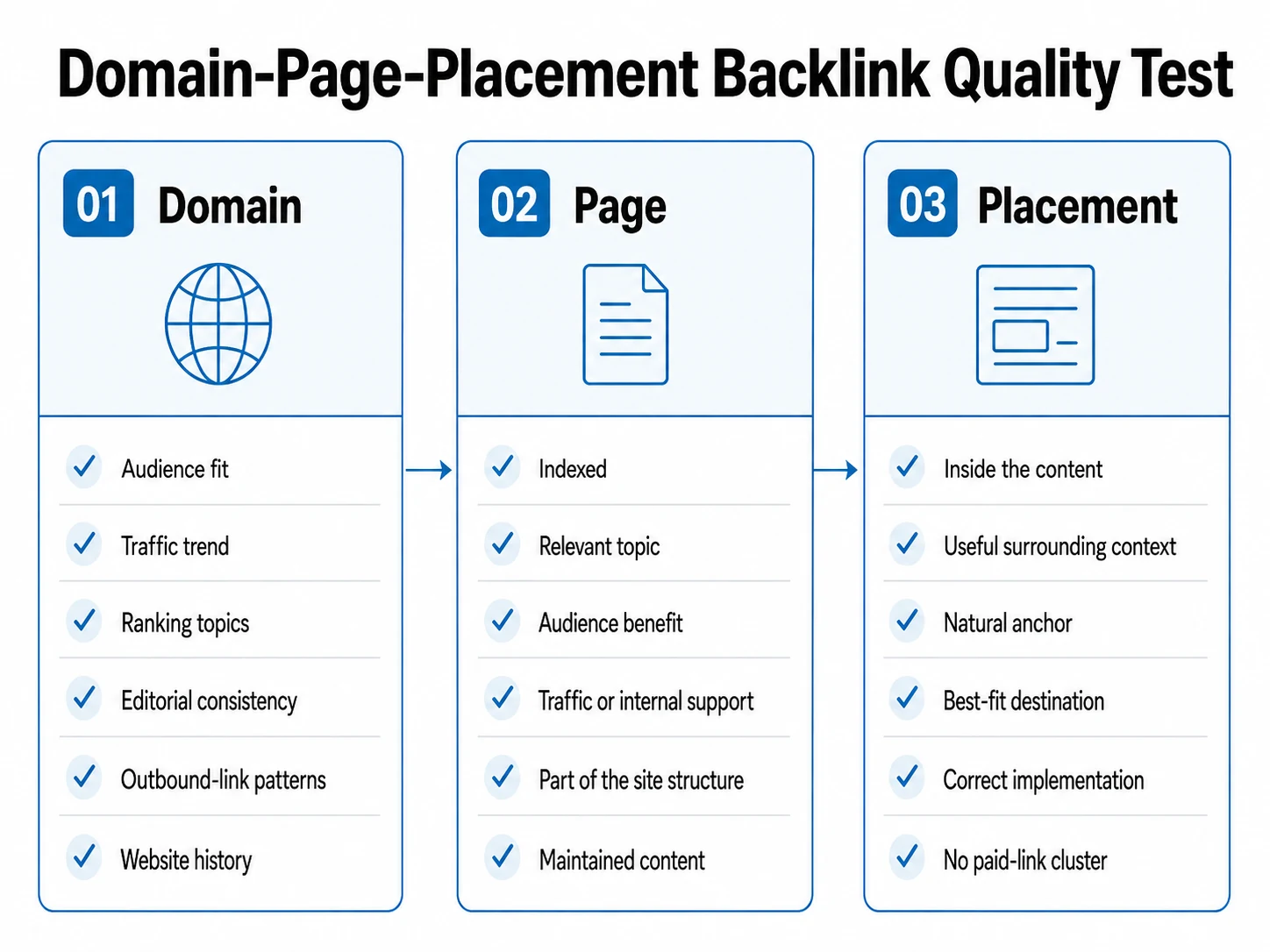
1. The domain test
- Check topical and audience relevance.
- Review estimated organic traffic and its trend.
- Inspect the keywords for which the website ranks.
- Read recent content and check publishing consistency.
- Review outbound-link patterns.
- Check the website's history and major topic changes.
- Look for evidence of genuine editorial control.
A high-DR website with falling traffic, unrelated rankings, and excessive commercial outbound links can be weaker than a focused lower-DR publication with real visibility in your market.
2. The page test
- Is the page indexed?
- Does its topic overlap with your product or content?
- Would its audience reasonably benefit from the destination?
- Does it receive traffic or meaningful internal support?
- Is it part of the publication's real content structure?
- Is the article maintained or abandoned?
A strong domain cannot rescue a completely irrelevant or buried page.
3. The placement test
- Does the link sit inside the main content?
- Does the surrounding passage explain why the destination is useful?
- Is the anchor text natural?
- Is the destination the best resource for that context?
- Is the link implemented as agreed?
- Is the page free from clusters of unrelated paid links?
A prospect may look credible during outreach, but the published placement can still be forced, isolated, or editorially weak. Review the live result, not only the domain spreadsheet.
Teams that want to compare potential publications can review Linkull's filtered publisher opportunities after defining their niche, audience, and target page.
12 SaaS link building strategies and when to use them
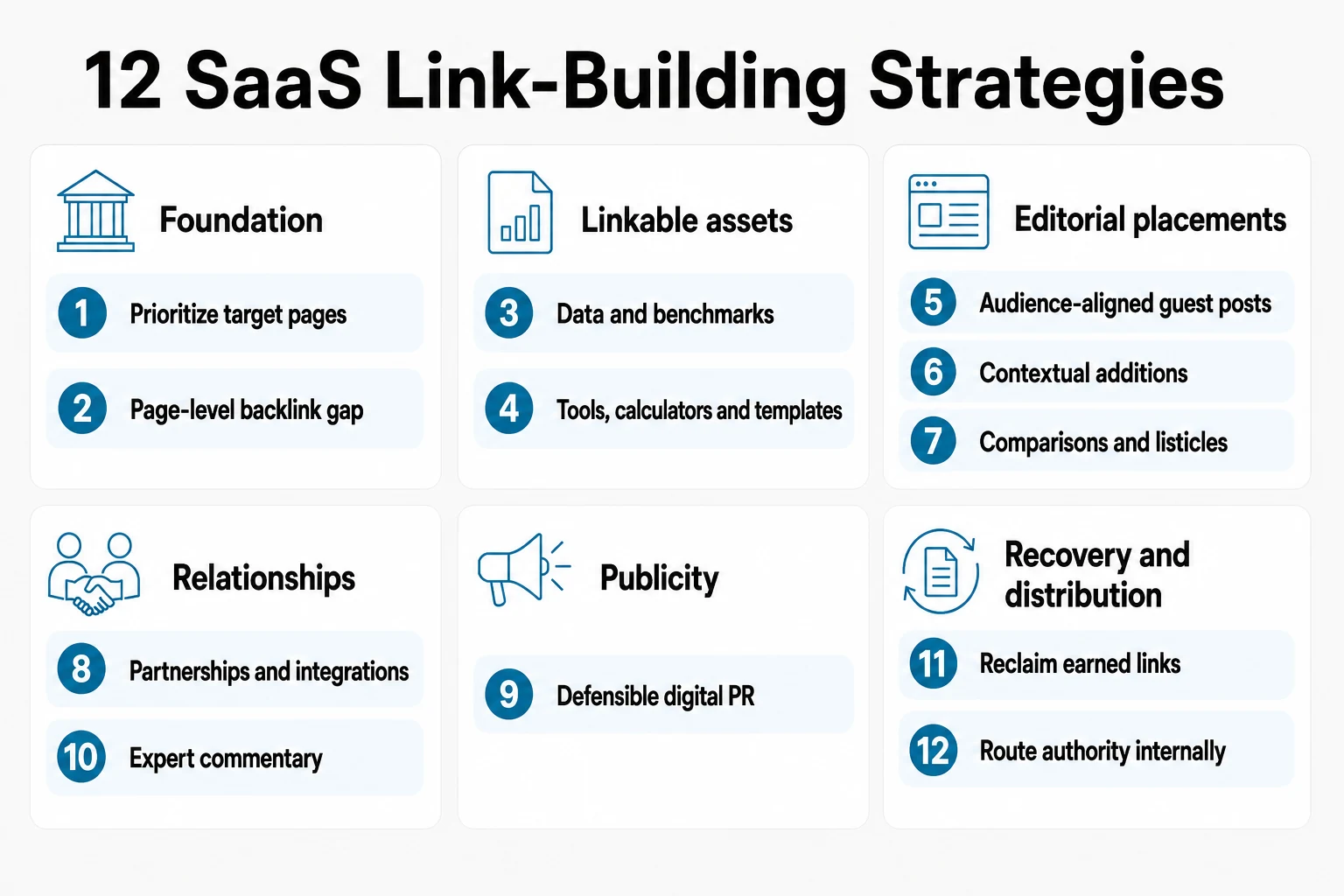
1. Prioritize pages before choosing websites
Do not begin with a target such as "build 20 links this month." Start by identifying pages that are:
- Commercially valuable
- Aligned with search intent
- Technically indexable
- Strong enough to compete
- Already ranking within a realistic striking distance
- Weaker than ranking competitors at the URL level
One mistake is spreading the budget across every product, feature, and blog page. That creates activity without concentrating enough authority to influence anything important.
In one Linkull page-prioritization case study, 23 submitted URLs were reduced to seven priority pages before link acquisition continued.
2. Run a page-level backlink-gap analysis
Domain-level comparisons show which competitor has the larger backlink profile. They do not necessarily explain why one specific page ranks higher.
Add the exact competing URLs to Ahrefs or Semrush and compare:
- Unique and relevant referring domains
- Homepage links versus page-level links
- Anchor-text patterns
- Repeated referring domains across ranking competitors
- Supporting internal links
A domain can have thousands of links while an important feature page receives almost no direct support. The opportunity is often to close a specific URL-level gap, not chase the competitor's total backlink count.
Having more backlinks doesn’t always mean better results. Linkull’s case study shows why focusing only on backlink totals can hide the real problems behind SEO performance.
3. Publish original data and benchmark reports
SaaS companies often hold information that a generic publisher cannot reproduce. Possible sources include:
- Anonymized product-usage data
- Customer surveys
- Support-ticket themes
- Workflow benchmarks
- Industry adoption patterns
- Aggregated integration data
The asset needs a clear finding, an accessible methodology, quotable takeaways, and useful charts.
Never expose confidential customer information or present a small, biased sample as representative of an entire market. Review established guidance on anonymising customer data before publishing product-usage findings.
4. Build tools, calculators, and templates
A useful tool gives writers, practitioners, and potential customers a reason to return and reference the page. Examples include ROI calculators, cost estimators, audit templates, migration checklists, and maturity assessments.
The strongest ideas sit close to the product's purpose. A project-delay cost calculator makes sense for project-management software. A generic mortgage calculator does not. The main trade-off is development cost, so validate demand before building a complex tool.
5. Use guest posting for audience overlap
Guest posting works best when the host publication serves people who could use, recommend, or influence the purchase of your software. Prioritize a useful editorial topic, genuine audience overlap, defensible insight, and a natural reason to reference the target page.
Do not treat guest posting as a way to repeat the same keyword-rich anchor across interchangeable blogs. The Bing Webmaster Guidelines identify link buying, link spamming, and artificial link schemes as manipulative practices.
If payment is involved, follow the publisher's disclosure requirements and use the appropriate link attribute. For US-facing placements, the FTC guidance for native advertising requires commercial content to be disclosed clearly and prominently.
6. Add valuable contextual links to existing content
A niche edit can work when an existing article is missing a resource, explanation, example, or current recommendation. The test is simple: Does adding this destination make the existing section more useful to its reader?
A forced sentence written solely to contain an anchor does not pass that test. Review the full page, publication date, search visibility, existing outbound links, and final wording before approval.
7. Earn inclusion in comparisons and listicles
SaaS buyers research categories, alternatives, integrations, and product comparisons before selecting a tool. Identify pages covering the best tools for a specific use case, alternatives to an established product, category comparisons, and software stacks used by a defined team.
Do not pitch only "Please add our product." Give the editor accurate positioning, limitations, features, screenshots, and a reason the product belongs in that particular list. These placements may influence referral traffic and consideration even when their SEO impact is limited.
8. Use partnerships and integrations
Integration pages, technology partners, certified consultants, app marketplaces, customer stories, industry associations, and co-created templates can produce highly relevant links.
Start with a real relationship. Do not create artificial partnerships solely to exchange links. The user benefit should exist independently of SEO.
9. Develop digital PR around a defensible story
Digital PR is not a press release sent to hundreds of addresses. A credible campaign needs a timely question, original or carefully analyzed evidence, a defined audience, a transparent methodology, and a story journalists can explain quickly.
10. Contribute useful expert commentary
Founders and subject specialists can contribute opinions to journalists, newsletters, podcasts, webinars, and industry articles. Strong responses are specific to the question, grounded in relevant knowledge, concise enough to quote.
Not every contribution will include the following link. It may still create a credible brand mention, qualified referral visits, a useful relationship, or future editorial opportunities.
11. Reclaim links you have already earned
Before starting another cold-outreach campaign, check for:
- Lost backlinks
- Unlinked brand mentions
- Links pointing to redirected or deleted URLs
- Incorrect product URLs
- Images reused without attribution
- Broken external links for which you have a suitable replacement
12. Route authority with internal links
Not every external backlink must point directly to a sales page. Some publishers will naturally reference a research report, calculator, or guide instead. That asset can then link internally to the commercial page it supports.
Use descriptive link text and a real topical relationship. This approach prevents every outreach conversation from depending on a direct link to a difficult-to-reference money page.
What most SaaS teams get wrong
- They choose the publisher before the page. A website can be relevant to the company but wrong for the destination URL.
- They confuse authority with suitability. DR, traffic, and traffic value are screening signals, not editorial decisions.
- They spread links too thinly. One link to each of 20 pages may create less competitive pressure than a focused plan for a few ready pages.
- They use anchor percentages as universal rules. Anchor decisions should reflect the live sentence, destination, existing profile, and acquisition reason.
- They approve the domain but never inspect the live placement. Incorrect URLs, awkward anchors, weak context, or unsuitable link attributes can appear after publication.
- They report activity without a decision. A monthly list of links does not show whether the campaign should continue, change, or stop.
What would we reject?
A relevance-first campaign should reject:
- Websites unrelated to the product, buyer, or topic
- Sites whose traffic is dominated by irrelevant keywords and
- Sharp, unexplained traffic declines
- Expired domains repurposed into generic publishing sites
- Pages filled with unrelated commercial anchors
- Content that appears mass-produced without editorial review
- Footer, sidebar, or sitewide links presented as editorial placements
- Forced exact-match anchors
- Publishers unwilling to show the final page
- Guaranteed ranking or AI-citation claims
- Placements whose only justification is a high DR
Automated toxicity or spam scores should not make the decision alone. Semrush's documentation recommends auditing backlinks individually before considering removal or rejection.
A rejection does not mean the domain is universally bad. It means the opportunity is unsuitable for that campaign, page, audience, or intended outcome.
What SaaS link building costs in time, money, and capacity?
Link-building cost is broader than a publisher fee or agency invoice. A realistic budget includes:
- Target-page and competitor analysis
- Prospect research and qualification
- Outreach and follow-ups
- Content or asset production
- Editorial coordination and placement-related costs
- Reporting, monitoring, and reclamation
- Internal review time
Asset-led campaigns usually require more upfront investment but can keep earning links. Outreach campaigns require recurring production. Digital PR may require research. An agency adds management cost but reduces the internal capacity required.
Linkull’s 2026 link-building pricing plan reports observed averages for guest-post links and link insertions, although quality, traffic, and service scope create substantial variation.
Do not judge the campaign only by cost per link. Ten unrelated placements and ten audience-relevant editorial links are not equivalent outputs.
Before approving a publisher quote, use Linkull's SaaS Backlink Value Estimator to compare price with relevance, traffic, placement quality, and risk.
Use Linkull's Link Building ROI Calculator to model traffic, conversion rate, attribution, gross margin, and payback instead of assuming every new visitor resulted from backlinks.
How to measure rankings, traffic, leads, and ROI?
Separate leading indicators from business outcomes.
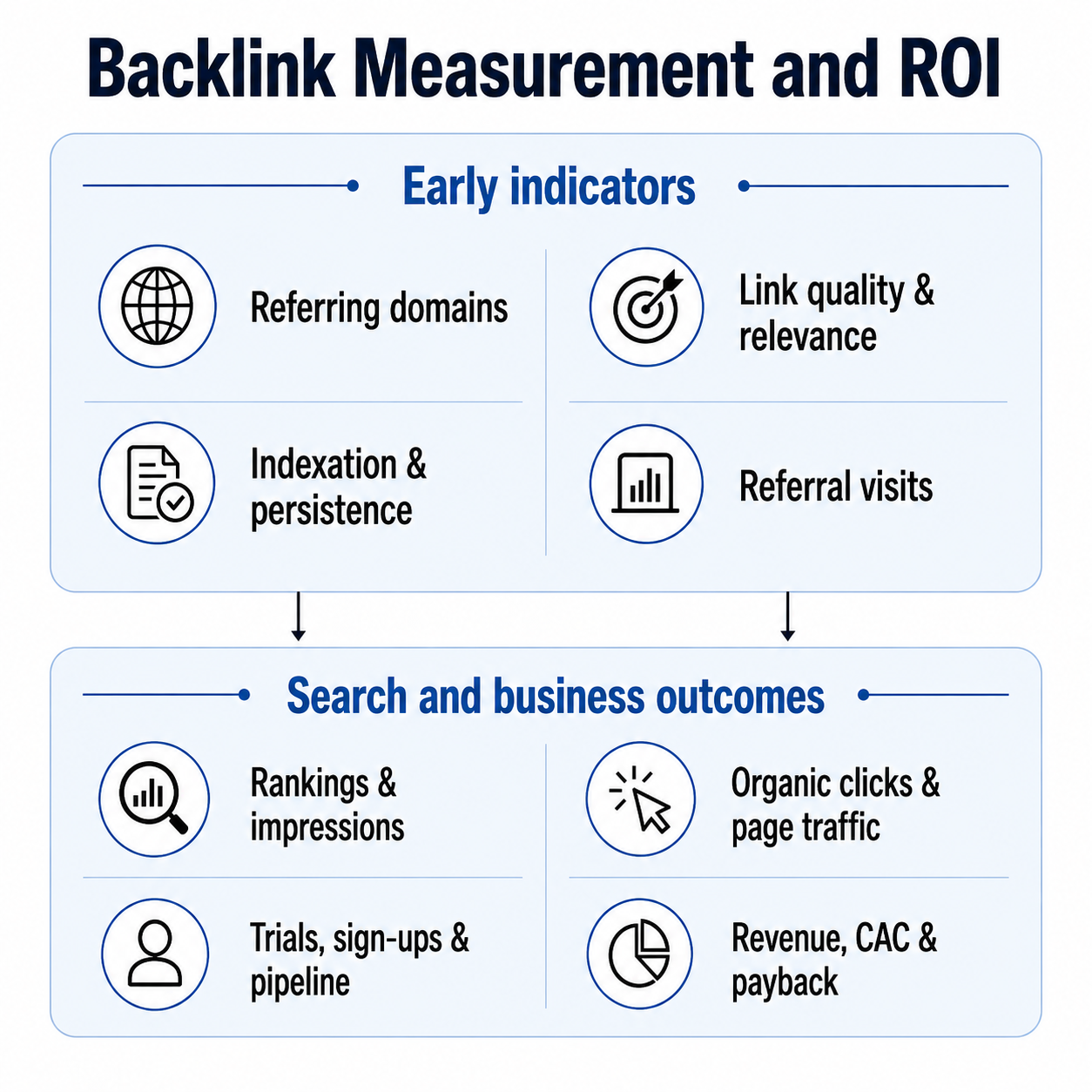
Leading indicators
- New unique referring domains
- Links pointing to priority URLs
- Percentage of prospects passing quality review
- Placement relevance and anchor-text diversity
- Link attributes and indexation
- Link retention and referral visits
A referring domain is a unique website linking to you. Multiple backlinks from one website still count as one referring domain.
Search and business outcomes
Use Google Search Console, analytics, and CRM data to monitor:
- Impressions for the target query group
- Average ranking trend
- Non-branded organic clicks
- Traffic to the priority page
- Trial, demo, or signup conversions
- Assisted pipeline
- Revenue, gross profit, acquisition cost, and payback
For a business-outcome example, how Linkull used paid-search conversion data to prioritize pages and grow organic SaaS leads.
Do not credit all organic growth to backlinks. Content improvements, technical fixes, brand demand, seasonality, and product changes may also contribute.
Use partial attribution and compare conservative, expected, and stronger scenarios.
Should you disavow bad-looking backlinks?
Do not automatically disavow every link labelled “toxic” by a third-party tool. Google says the disavow tool is an advanced feature that most sites do not need.
Google recommends it when a site has a considerable volume of artificial or low-quality links and those links have caused, or are likely to cause, a manual action. Using the tool incorrectly can harm search performance.
A practical 90-day execution framework
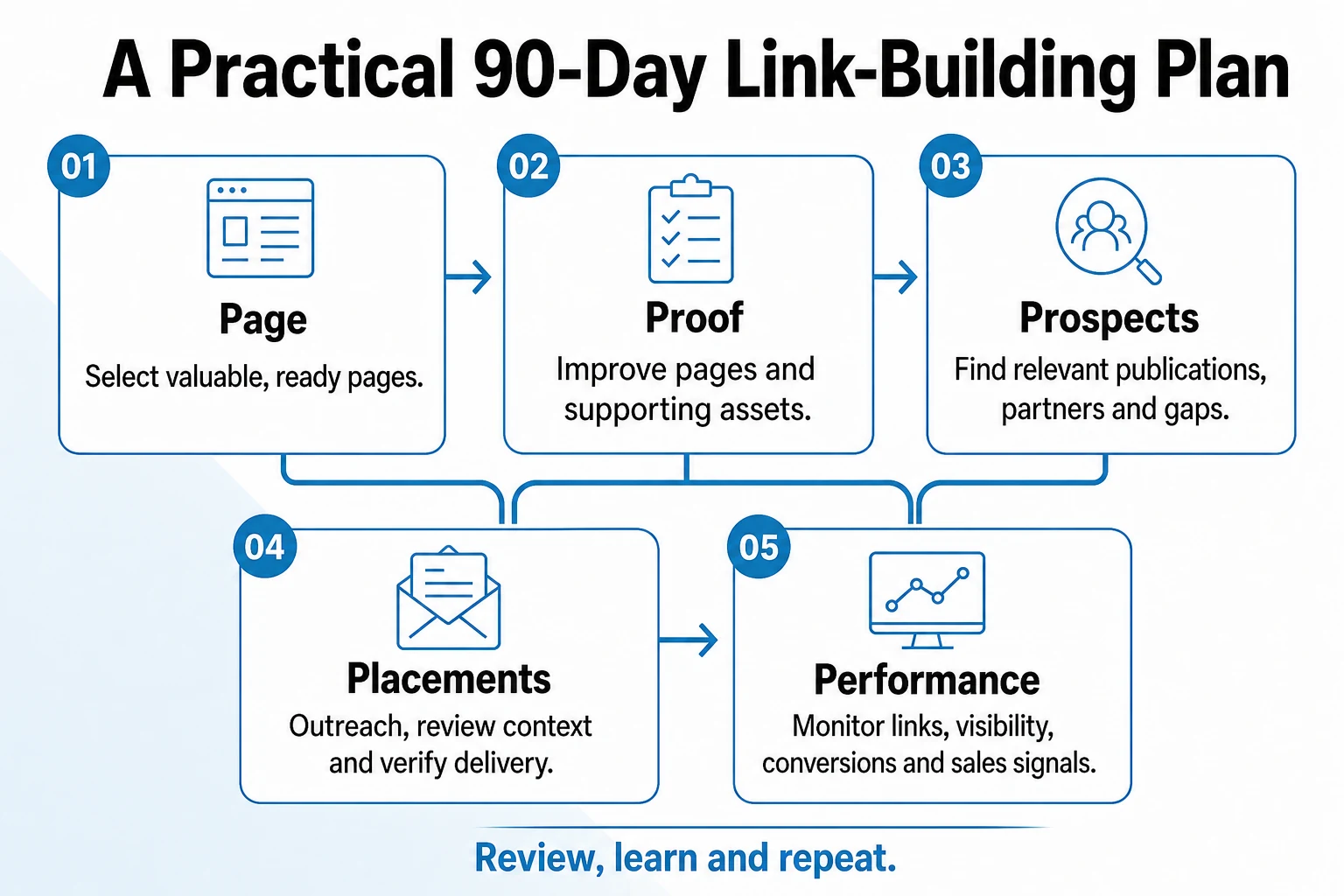
Page: Select a limited set of priority pages using commercial value, current rankings, content readiness, and competitive gaps.
Proof: Improve those pages and create supporting assets before asking other websites to reference them.
Prospects: Use competitor gaps, audience research, partnerships, and relevant publications to build a qualified list.
Placements: Run personalized outreach, review the final context, use natural anchors, and verify implementation.
Performance: Monitor live links, target-page visibility, organic conversions, and early pipeline signals before planning the next cycle.
Use the SaaS Link Building Checklist to confirm page readiness, prospect quality, outreach controls, placement QA, and measurement before launch.
Conclusion
The best SaaS link-building strategy starts with the right pages, not a backlink quota.
Focus on relevant, high-quality placements that give publishers and readers a clear reason to reference your content. Prioritize page-level gaps, audience relevance, and opportunities that support real business goals.
Measure rankings, traffic, leads, and revenue, not just the number of links acquired. Reject placements that rely on high DR alone, weak relevance, or artificial link-building tactics.
Ultimately, build links with purpose: the right links to the right pages can support sustainable SaaS growth.
Frequently asked questions
How many backlinks does a SaaS website need?
There is no universal number. Compare referring domains at the ranking-page level, assess content and domain strength, and estimate the gap for each priority URL. Some pages need several strong links, while others need content or technical improvements first.
How long does SaaS link building take to work?
Links can be discovered quickly, but ranking and traffic changes may take weeks or months. Timing depends on the target page, competition, relevance, indexing, existing authority, content quality, and other SEO work.
Is Domain Rating important?
DR is useful for comparison and prospect filtering, but it should not determine approval by itself. Relevance, traffic quality, editorial standards, page context, and audience fit provide a more complete evaluation.
Is guest posting safe for SaaS companies?
Editorial guest contributions can be useful when they serve the publication's audience. Large scale, keyword-optimized, or paid placements designed to pass ranking credit can conflict with search-engine spam policies.
Should backlinks point to the homepage or product pages?
Use both where context supports them. Brand citations may naturally point to the homepage, while page-level ranking gaps may justify links to feature, comparison, or resource pages. Do not force every link toward one destination.
Can backlinks guarantee AI citations?
No. Relevant links and accurate brand mentions may improve online discoverability, but no placement can guarantee a ChatGPT citation. OpenAI's publisher guidance explains that websites can allow to track ChatGPT referrals through AI visibility separately from Google rankings.
Build links around a reason, not a quota
The strongest SaaS link building strategies begin with a page, problem, audience, and measurable outcome. Do not build links because a monthly spreadsheet needs another row. Build them because a relevant page deserves stronger authority.
Need a clearer SaaS backlink plan?
If your team does not have the internal resources to manage page selection, prospect qualification, outreach, content, and monitoring, Linkull can first review your priority pages and competitor gaps.